Wednesday, December 29, 2010

What's with the bluish lighting on CTA buses?


by John Greenfield

[This article also runs in Time Out Chicago magazine, www.timeoutchicago.com.]

Q: What’s up with the weird blue lighting inside CTA buses in the past year or so (and now in some CTA train cars as well)? It looks like if you took some dirty combs in there, they’d come out clean! — Joe Bogdan

A: That bluish glow inside some buses and trains comes from new LED lighting that has replaced fluorescent bulbs, according to CTA spokeswoman Wanda Taylor.

In fall 2009, the agency added 58 articulated hybrid buses, bankrolled by federal stimulus money. The new vehicles are less polluting, quieter and a smoother ride than conventional buses, and the new LEDs on these vehicles are a greener, lower-maintenance choice since there are no bulbs to change, Taylor says.

This year the agency has also been testing interior LED lighting on its rail system, although the higher cost of the LEDs and difficulty keeping a steady voltage on the trains may prevent them from changing the lighting system-wide.

The CTA is also considering adding color-coded LEDs on the outsides of train cars, Taylor says, so that when you’re standing on, say, the Fullerton platform it will be obvious whether a particular train serves the Red, Brown or Purple Line.

Thursday, December 23, 2010

Rough ride: the transit agencies tighten their belts


By John Greenfield

Photos by Gilbert Feliciano

[This article also ran in New City magazine, www.newcity.com.]

On an icy Monday night a handful of citizens has braved to cold to visit the Loop office of the Regional Transit Authority, which sets the budgets and provides oversight for CTA, Metra and Pace. They’re here for the last of several public hearings on the RTA’s 2011 financial plan. Several of the attendees are transit activists who show up regularly for these kind of meetings. There are also a few people with disabilities here, and there’s a sign language interpreter at the front of the room.

Joseph Costello, the RTA’s mild-mannered executive director, starts the hearing by explaining how the sour economy has impacted the three transit agencies. Reduced consumer spending means the RTA’s largest source of public funding, a 1.5 percent cut of Cook County sales tax receipts plus .5 percent of receipts from the five collar counties, dropped from about $750 million in 2007 to roughly $650 in 2010. Meanwhile, the cash-strapped state government has been delaying its payments to the RTA, making it tough for the transit oversight body to pay its own bills.

Joseph Costello

In response to these funding problems Costello says CTA, Metra and Pace are making financial sacrifices. 2011 budgets are smaller, there have been over 1,000 employee layoffs and, like eighty percent of transit agencies around the country, they’ve cut service and hiked fares. On the bright side, while regional transit service has been reduced by three percent, ridership is only down by one percent, he says.

Although the three agencies will have smaller capital budgets next year, Costello says the RTA is studying the condition of tracks, stations and other infrastructure for future improvements. “The engineers tell us if we were to rebuild our regional transit system from scratch it would cost us $52 billion, so it’s a valuable asset we should invest in and preserve,” he says.

When the floor is opened to comments Heather Armstrong, who uses a wheelchair, argues that Metra and Pace offer cleaner buses and trains, and better customer service than CTA. “You should give the CTA train system to Metra and the bus system to Pace,” she says.

Charlie, a senior with a crew cut who’s a member of the transit workers union and the transit advocacy group Citizens Taking Action says he’s worried about future layoffs. “The union drivers ain’t got no contract,” he says. ‘Will there be three, four, five thousand more layoffs next year?”

The City of Evanston’s Matt Swentkofske says, “Evanston is very blessed to be served by CTA, Pace and Metra.” He asks Costello for help getting three rail viaducts rebuilt in the village. “Let us know what kind of lobbying we can do.”

Kevin Peterson, a young man in fatigues and combat boots who says he’s with the group Citizens Against Terrible Transit Service, rants against faulty fare cards, bus drivers who refuse to lower access ramps, and the RTA’s efforts to end the free rides for seniors program. “You guys are supposed to make sure CTA, Pace and Metra get along,” he says. “You’ve been deadbeat parents.”

Saturday, December 11, 2010

Give a Minute wants your car-free travel ideas


By John Greenfield

Ever wish you could stick a Post-it note on the computer screen of an influential city planner with your idea about how to make it easier to walk, bike or use transit in Chicago? The Give a Minute campaign gives you a chance to do just that.

Launched in Chicago on November 2 by CEOs for Cities, an urban planning think tank, the campaign allows citizens to share their ideas for improving car-free travel with the public as well as key leaders in the city’s green transportation scene. These suggestions appear as colorful notes on the website www.giveaminute.info. You can post your ideas on the website or text them to 312-380-0436 until December 10.


A quick look at the Post-its on the website provides fast food for thought, ideas for better biking, walking and transit in a format that makes Twitter seem long-winded. “Make sure heaters are working at all stations,” says one post. “Chicago winters are brutal.” “Free or reduced-price bike maintenance and basic repair classes,” says another. I posted, “Better-marked crosswalks, and more enforcement of laws requiring drivers to stop for pedestrians in the crosswalks.”

On December 8-10, CEOs for Cities and the Chicago Architecture Foundation will host the Connectivity Challenge, a conference bringing together national urban planning experts and local transportation and planning agencies to discuss the best of the car-free transportation ideas harvested from the website. According to the organizers, the goal of the symposium is to produce new ideas and “quick start” strategies that will be promoted in book form, through a promotional tour and as a national policy platform.


I called CEOs for Cities communication director Natalie Campbell for details about the project.


What is the campaign all about?


We worked with a company out of New York called Local Projects to develop this campaign. The idea was public engagement through technology. The campaign is launching in Chicago and we’ll take it to other cities as well, including Memphis, San Jose and New York.

In Chicago the idea is to start a public dialogue about how we can make it easier to get around the city without a car. The CTA is a sponsor of the campaign, so we have about car card ads in CTA buses and trains. We’re promoting the campaigning the campaign throughout the city, asking, “Hey Chicago, what would encourage you to walk, bike or take CTA more often?”

We worked with Terry Peterson, the chairman of the CTA, Ron Burke with Active Transportation Alliance and Stan Day with SRAM [a Chicago-based bike parts manufacturer] to be our faces of the campaign, our “response leaders.” They’re the people asking that question to citizens.

So we launched the campaign about two weeks ago and so far we’ve had over 500 responses and they’ve all been really good responses. We’re pretty excited about the campaign. We’re compiling all these recommendations and saying, what are the common themes here? Then we’re holding an event December 8th through the 10th called the Connectivity Challenge.

That event will together nine national experts on transit mobility and accessibility and a group of local stakeholders which includes some of the local stakeholders: the CTA, Active Transportation Alliance, the Regional Transportation Authority, CMAP [Chicago Metropolitan Agency for Planning, Metra, the Chicago Department of Transportation. It will bring all those people together to explore this ambition of a future where Chicago residents can get around more easily without a car.


So you’re collecting all these ideas, all these electronic Post-it notes. How will these ideas guide the recommendations of the Connectivity Challenge?

The format of this event is the local stakeholder teams are going to present existing projects and goals for the future. This national team is coming to town with a fresh eye and a different perspective. They’re going to be working hard and working fast over two and a half days to explore what we call “twelve big ideas.” We’ll take the citizens’ responses and narrow them into the categories of biking, walking and CTA.

So if someone is saying “more bike lanes” we’re letting the local and national experts know this is what we’re hearing from the people. We’ll think about how we can turn these recommendations into big ideas, whether it’s infrastructure or policy recommendations.

What is a “quick start strategy”?


A quick start strategy could be something small, like Chicago businesses setting up bike training programs for their employees. For example, Active Transportation alliance has people who go into companies and say, “Don’t be afraid to ride your bike to work – here’s some easy tips on how to navigate around the city.” Because a lot more people are biking now but it’s still a segmented audience. So if you can reach out to other people and make them not as wary of riding their bikes, then you’re expanding ridership.

I was at a meeting where we were discussing other quick start ideas and one of them was making sure people have bike racks at their offices because a lot of people have trouble parking their bikes when they get to work. Or at the el stops, making sure that there are bike racks there. Because when we’re talking about connectivity it’s not just not just biking or walking. You can ride your bike to an el stop, jump on the train and get to work, but you need to have a bike rack at the el station.

So what are you guys hoping to achieve with this campaign?


The big ambition is to create a future where it’s easy to get around Chicago without owning a car. In the short term, people are always looking for ways to be engaged and this program is a way for citizens to talk back to their city and having them feel like they have a say in it. We really are connecting them with change-making leaders. Terry and Ron and Stan are responding directly to some of the best recommendations. And there really are a lot of great recommendations on the site.

So we’re bringing those ideas to our national, or international, expert team. We have Jan Gehl from Denmark who’s one of the world’s foremost urban planners and architects. So you really do have a say. And that’s the challenge people have, feeling that they really are able to help create change, so programs like this help people feel like they can make a difference.

Saturday, December 4, 2010

Citizens sound off on the CTA's 2011 Budget


By John Greenfield

[This article also runs in New City magazine, www.newcity.com.]

It's Tuesday evening at the Chicago Transit Authority’s headquarters, 567 W. Lake, and a few dozen citizens file through the lobby with its life-sized cow sculpture, plastered with photos of CTA stations, then up the stairs and past a 3D neon rendition of an “L” train zooming by skyscrapers. They’re here to offer their two cents on the agency’s proposed $1.337 billion budget for 2011 at one of four public hearings being held across the city.


Last winter the transit authority tightened its belt by cutting nine express buses, reducing service hours on 41 bus routes, and providing less-frequent service on 119 buses and seven of the eight rail lines. The goal for 2011 is to hold the line on fare increases and service reductions, despite the bleak economic picture.

This new budget is actually 5.2 percent larger than last year, partly due to pay raises, healthcare and pension costs required by the agency’s contract with its union workers, according to management. “Balancing the budget was very challenging this year,” says CTA president Richard L. Rodriguez in a press release. “Nevertheless, the CTA expects to accomplish a great deal in 2011 and it will do so by being resourceful and innovative.” On the plus side, next year the agency will be adding new, smoother-running rail cars to the system and debuting a “Train Tracker” service.

At the hearing, as folks take turns stepping up to a microphone to have their say, Rodriguez and the CTA board members sit stoically at the front of the room, showing no emotion even when confronted by the more eccentric and irate speakers. The attendees are a racially mixed, blue-collar crowd, including several non-union employees who lost their jobs in the last round of cuts, wearing “Laid-off CTA worker” t-shirts.

“It’s good that we’re having no further reductions in service or increases in fares,” says transit activist Les Slater. “But we’ve already had reductions and increases, and there’s plenty of money to go round. When the banks need cash they get a bailout, but the majority of people served by the CTA don’t have political power – they need to organize.”

Laid-off CTA mechanic Ricky Anderson tells the board he’s anxious to turn a wrench again and frustrated to see recent job openings at the garages go unfilled. “I’m praying that when you get the money you’ll re-hire the workers,” he says. The meeting facilitator takes down his number and promises to have the HR department call him.”


A woman describes how a non-employee was somehow able to steal a bus from the 103rd Street garage and pick up passengers and argues that if the public was allowed to monitor the CTA’s security camera system it might be easier to stop crimes in progress. “It really takes a lot of eyes to see what’s going on in the system,” she says.

Lawrence Msall, president of the Civic Foundation, a tax policy and government research organization, recommends repealing Blago’s free rides for seniors program. “We’re losing $25-70 million a year in revenue and it will only get worse as the population ages,” he argues.

George, a wild-eyed, slightly disheveled man who’s a regular at Cook County board meetings, takes the mic to complain about the relatively low attendance at this hearing due to the out-of-the-way location. “It’s appalling,” he says. “When these meetings were at the State of Illinois Center there used to be hundreds of people lined up to get in.” He keeps ranting about other topics well after his allotted time runs out and the facilitator sternly asks him to step down. George turns to the audience and says scornfully, “I think they deliberately try to distract me when I speak.”

Friday, December 3, 2010

Celebrating the launch of the GO TO 2040 plan


Local leaders party like it's 1909 at the launch of Chicagolands’s first major urban planning blueprint since Burnham

By John Greenfield

[This article also runs in New City magazine, www.newcity.com.]

It’s pouring, but that doesn’t dampen the spirits of a thousand sharp-dressed politicians, urban planners and other civic leaders crammed into a tent on top of Millennium Park’s Harris Theater. They’re here to launch GO TO 2040, a blueprint for making tough development and spending choices in the Chicago area’s 284 communities, for the next few decades and beyond.

The Chicago Metropolitan Agency for Planning (CMAP) will lead the implementation process, and stakes are high. As the region’s population balloons from its current 8.6 million to an estimated 11 million by 2040, the decisions we make now will determine whether Chicagoland becomes more prosperous, green and equitable or devolves into a depressed, grid locked, smog-choked dystopia.

The plan, developed by CMAP its partner organizations over three years and drawing on feedback from over 35,000 residents, includes the four themes of Livable Communities, Human Capital, Efficient Governance and Regional Mobility. It makes detailed recommendations for facing challenges like job creation, preserving the environment, housing and transportation.

Banners at the launch party feature GO TO 2040’s cover image, an Aurora-centric aerial view of the region, with expressways and transit lines radiating from Chicago like bolts of lightning. Considering that this is a plan for future generations, affecting people from all walks of life, it’s odd that almost everyone on the stage is an older, white male in a dark suit.


CMAP board chairman Gerry Bennett, mayor of Palos Hills, kicks off the proceedings by comparing the occasion to the 1909 release of Daniel Burnham’s “Plan of Chicago,” which helped create a city with plentiful parks and preserved the lakefront for public recreation. “When Burnham proclaimed ‘Make no little plans,’ he asserted that as a great metropolis we have the ability to reach for the unreachable,” Bennett says.

Senator Dick Durbin highlights the importance of local leaders working together to improve the region, and he warns the crowd that implementing GO TO 2040’s strategies during the current financial woes is going to take grit and perseverance. “We have one thing on our side,” he says. “A president who loves Chicagoland as much as we do.”

Senator Durbin, seen two days later listening to blues at Rosa's

WTTW’s Geoffrey Baer moderates a panel discussion on the urgency of long-range planning and the economy that includes a fired-up Mayor Daley, wearing his trademark scowl. Daley says Chicagoans, and Americans in general, need to be more optimistic about our future. “Until we get our confidence back other countries will look at us as whiners.”

Michael Moskow from the Chicago Council on Global Affairs argues higher road tolls and parking fees are needed to reduce car dependency. “As you raise the cost of driving and make transit more attractive, more people will make the shift.” But George Ranney, head of the pro-business organization Metropolis 2020, scoffs, “Some of my friend’s radical ideas are not actually in the plan.”

Baer closes the discussion by recalling the words of businessman Charles Wacker upon the publication of the Plan of Chicago: “This will be remembered 80 years later as the day that gave Chicago the most beautiful lakefront in the world.” Today’s launch of GO TO 2040 is a similar occasion, Baer says. “Many of the people here today won’t live to see the results, but we can hope for them.”

A tale of two road diets

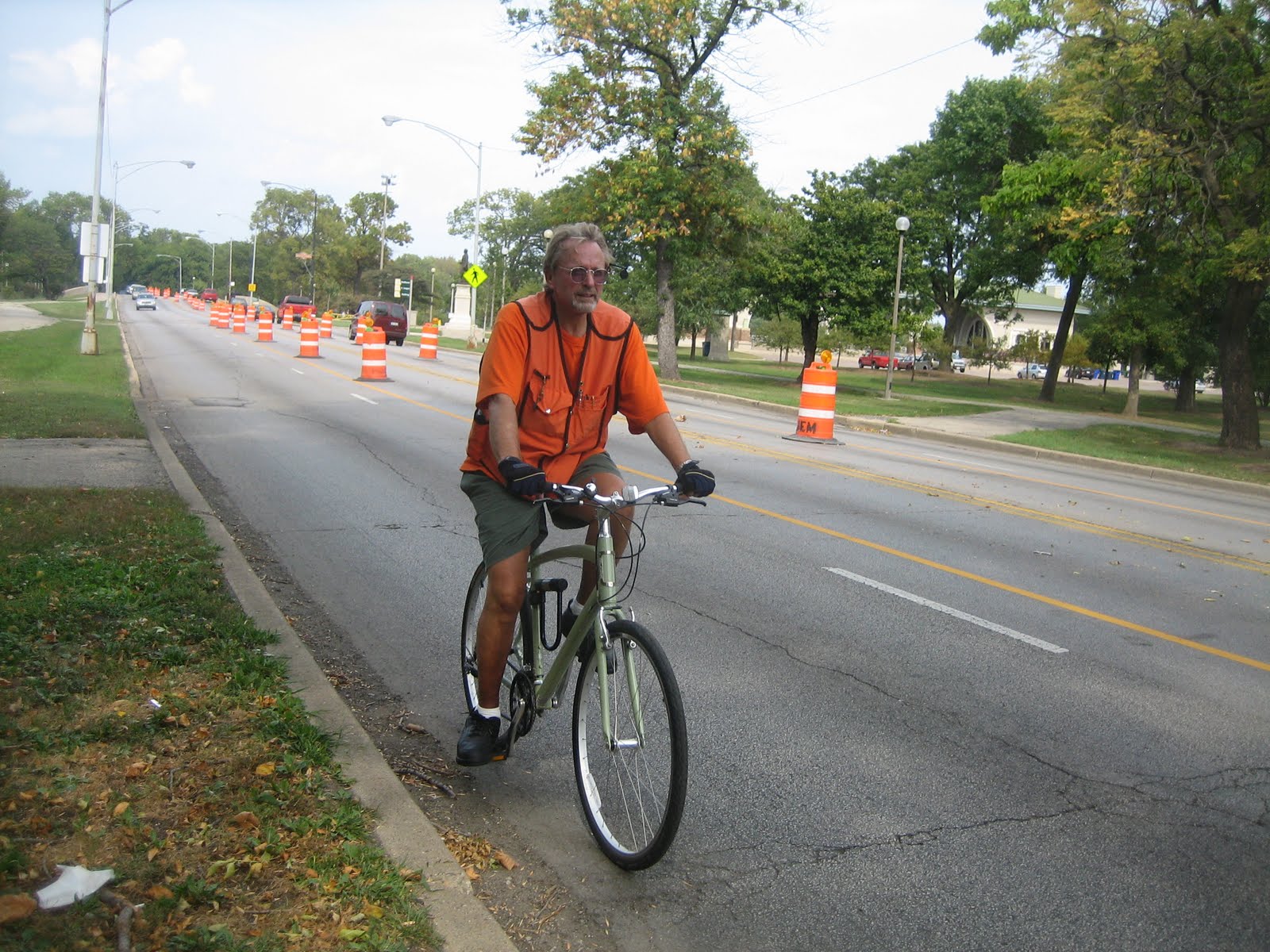
The road diet pilot in Humboldt Park (posed photo)

New “road diets” aim to beef up safety by slimming down streets, but will bicyclists get their piece of the pie?

by John Greenfield

[This article also appears in Time Out Chicago magazine, www.timeoutchicago.com.]

Cities across the country are seeking to improve safety through the so-called road diet—narrowing or removing street lanes to calm traffic and create more space for pedestrians and bicyclists. “A major benefit is reducing vehicle speeds and focusing attention on the other public-way uses,” says Chicago Department of Transportation (CDOT) spokesman Brian Steele.

Now the city is planning to give Lawrence Avenue in Lincoln Square and Humboldt Drive through Humboldt Park a traffic tummy tuck. “It’s a shift in the way [the city is] thinking about streets,” says Active Transportation Alliance’s Adolfo Hernandez. “The aldermen for both projects have been very supportive. Taking away a lane of traffic is not easy to do—it takes political will.”

The $12 million Lawrence streetscape project, tentatively scheduled to start next year, stretches between Western and Ashland Avenues and will slim the avenue from its current four travel lanes to one lane in each direction with a center turn lane, Steele says. This “four-to-three conversion” will provide space for wider sidewalks, curb bump-outs, pedestrian refuge islands and new bike lanes.

This is what Lawrence currently looks like.

This is what Lawrence will look like after the road diet is implemented.

The streetscape also will provide more space for sidewalk cafés and make it easier to pedal to the lake, says Dan Luna, 47th Ward chief of staff. “Lots of people have been contacting our offices requesting safer bike routes,” he says.

Eric Holm, manager of On the Route Bicycles (2338 W Lawrence Ave), applauds the change. “Lawrence is pretty intimidating for beginning riders,” he says. “Adding bike lanes means more people will be riding past our store and shopping here.”

The Humboldt Park road diet is proving to be a bit more controversial. Since August 23, CDOT has been working on Humboldt Drive from North Avenue to Division Street, the high-speed roadway dividing Humboldt Park. It temporarily changes the four-lane street into two travel lanes with a center lane used as a combination left-turn lane and pedestrian refuge area, using orange traffic barrels to keep moving cars out of the center lane. After CDOT analyzes the effects on traffic speed and behavior, Steele says, the changes may become permanent next year.

Roberto Maldonado, 26th Ward alderman, helped push for the project after his office received many complaints about speeding traffic and difficulty crossing the street, says Maldonado’s chief of staff, Kathleen Oskandy. “A lot of them were from young moms with baby strollers,” she says. Although residents proposed adding stoplights, stop signs and speed humps, Oskandy says federal constraints on the historic boulevard limited those options.

Not everyone is enthusiastic about the experimental setup, which, unlike the Lawrence road diet, does not include the addition of bike lanes. Oskandy says there was initial talk of including them, “but the first plan of attack was to slow down the traffic, so bike lanes might have added to the confusion.”

Drivers we talked to felt comfortable with the new configuration, but cyclists didn’t. During a half-hour period on a recent Tuesday afternoon, a handful pedaled on the asphalt paths that run parallel to Humboldt Drive, but no one attempted to ride in the newly slimmed street. “I’m a little afraid to bike in the street now,” said Jim Stablein, 58. “Cars can’t squeeze by you.”

Jim Stablein (posed photo)

Although the city-issued Chicago Bike Map designated this segment of Humboldt Drive for years as a cycling-friendly street, CDOT removed it from this year’s edition, recommending a stretch of nearby Kedzie Avenue as the safer route. As a result, the two-mile stretch of Humboldt (called Sacramento Boulevard south of the park) between Armitage Avenue and Franklin Boulevard is virtually the only segment of Chicago's 28-mile historic boulevard system that is not recommended as a bike route. Since Humbolt is no longer a recommended route, it's not under consideration for bike lanes, says CDOT bikeways engineer David Gleason.

That’s unfortunate, says Todd Gee, president of the nonprofit alt-transportation org Break the Gridlock. “The new travel lanes aren’t wide enough for cars to safely pass bicyclists. It’s fantastic they’re doing something about speeding and making it more pedestrian friendly, but it’s disappointing that they’re not accommodating bikes.”

Ash Lottes, who takes her son to pre-school by bike via the park, says she met with Maldonado on September 21 to discuss the possibility of adding bike lanes and sidewalks along Humboldt. She provided the alderman with blueprints for alternate street configurations that would include bike lanes.

“He told me that he has no intention of adding a bicycle lane or any other accouterments on that stretch because ‘the road is too dangerous for pedestrians,’” she says. Lottes recently posted on the local bike website thechainlink.org, asking members to lobby Maldonado for bike lanes on Humboldt. “To me the road seems too dangerous for pedestrians because there are no sidewalks, crosswalks or bike lanes.”
Going Dutch at the ThinkBike symposium


By John Greenfield

[This piece also runs in New City, www.newcity.com.]

On a balmy Wednesday morning, bike racks outside the Thompson Center are clogged with cycles. The drum-shaped building is nicknamed the “Tom Tom” by messengers who chill in the plaza while waiting for work. But today a cleaner-cut crowd has pedaled here in suits and skirts for the ThinkBike symposium, “a Dutch boost to Chicago’s bike-ability.” Naturally, the collection of cycles includes elegant Dutch city bikes and hardworking bakfiets (“box bike”) cargo vehicles.

The workshops, sponsored by the Dutch Consulate General and Active Transportation Alliance, bring bike transportation specialists from the Netherlands together with their Chicago counterparts to brainstorm ways to make our city the Amsterdam of the Midwest. Rather than legalizing pot and prostitution, the goal is to bump our city’s measly one-percent bicycle mode share closer to the utopian standards of Holland, where 27 percent of all trips are made on two wheels, and there are more cycles than citizens.

The visitors from the Netherlands are stylishly dressed in sports jackets and Beatle boots, and most of them are freakishly tall. In the afternoon these flying Dutchmen will pedal their fietsen around town with local politicians, transportation planners and bike advocates, discussing ways to create safer, more appealing streets for cycling.

Active Transportation Alliance's Adolfo Hernandez

Emcee Geoffrey Baer, host of WTTW’s November 29 special “Biking the Boulevards,” kicks off the session with a discussion of our town’s rich bike history. “In the 1890s Chicago was the bicycle manufacturing capital of America,” he says. “Two-thirds of American bicycles were made in the region.” It turns out Richard J. Daley wasn’t the first mayor to push pedaling here – in the 1897 mayoral campaign Carter H. Harrison II coasted to victory with the campaign slogan “Not a Champion Cyclist; But the Cyclist’s Champion.”

Hans Heinsbroek, Consul General of the Netherlands, takes the podium and boasts that his country has 13,000 kilometers of bike paths, tens times more than the total length of highways, noting “The bicycle is the cleanest, most sustainable form of urban transportation.” Heinsbroek says Baer has asked him to read the guttural-sounding names of the other Dutch speakers. “Because, you know, Dutch is not a language but a throat disease.”

Hans Voerknecht, a sustainable mobility consultant, contrasts American and Dutch attitudes towards biking and driving. While most while most kids in Holland bike to school, many U.S. principals forbid their students to pedal to class. “People say the car is the symbol of American freedom,” he says. “But I don’t feel free when I’m sitting in a cage, stuck in traffic.”

Bike policy expert Arjen Jaarsma offers encouragement to Chicagoans who feel that promoting cycling is an uphill climb. He shows a graph illustrating how Dutch cycling dropped off sharply with the rise of car culture after World War II and has only recently recovered to its current levels, after lots of hard work.

Jaarma shows a YouTube video of shiny, happy people navigating the Dutch capital on two wheels and he points out that no one is wearing a helmet. “Bicycling is so normal and the infrastructure is so good there’s no need for them.” The clip features a bumping rap soundtrack: “Step on your pedals and listen to the mic / This is Amsterdam and this is my bike.”