Showing posts with label Humboldt Park. Show all posts

Friday, June 3, 2011

A bike tour of Humboldt & Logan Square history


by John Greenfield

[This piece also appears in Time Out Chicago magazine, www.timeoutchicago.com.]

Time Out recently invited me to test ride the following bike tour which you can ride in later this month:

GUIDE Chicago Architecture Foundation
LENGTH 3.5 miles, 2 hours
STARTS AT Humboldt Park Boathouse (1401 N. Humboldt Dr.)
NEXT TOUR June 18 at 11am; $15, free for CAF members. Bring your own bicycle and helmet. Future tours TBD.

“We’re going to point out little details you’ve never noticed in buildings you probably go by all the time,” promises Chicago Architecture Foundation (CAF) docent Tom Drebenstedt, straddling an old-school Fuji Sandblaster mountain bike by the stately Humboldt Park Boathouse (1401 N. Humboldt). For years he’s led the CAF’s Bike the Lakefront tour (caf.architecture.org) showcasing the history of Chicago’s shoreline. On this gorgeous spring morning he’s leading me on a new route highlighting Humboldt Park and Logan Square’s architectural gems.


Nearby stands an 1892 statue of Prussian naturalist and explorer Alexander von Humboldt with an adorable bronze lizard crawling on a manuscript by his feet. Crossing von Humboldt’s namesake boulevard to the west side of the park, Drebenstedt points out the man-made river created by Danish immigrant Jens Jensen, who quickly rose up the Chicago Park District’s ranks to become its foremost landscape architect. Recently the park district installed solar- and wind-powered pumps to create a current and prevent stagnation.


Two blocks south is the circular rose garden Jensen designed, flanked by bronze bison and Japanese-inspired light fixtures. I suspect that two men in hoodies lurking beneath the trellis on the far side of the garden are doing a drug deal. We roll across Division Street to the 1895 Humboldt Park Stables (1150 N. Humboldt), with Hansel-and-Gretel-esque gables and half timbers, slated to re-open as the Institute for Puerto Rican Arts and Culture.

Humboldt Park Stables - Jens Jensen's office was in corner turret

Rolling north along the park’s perimeter trails, we startle a pair of young women sashaying down the path, then catch a whiff of roast pork from La Esquina del Sabor food truck (1500 N. Humboldt). Drebenstedt pulls over at North/Humboldt by a kiosk outlining the development of the Boulevard System. In 1870 the West Park District hired architect William Le Baron Jenney to design the major western parks, including Humboldt, and tree-lined thoroughfares to connect them.

As we pedal north up the quiet service drive along Humboldt Boulevard Drebenstedt points out the occasional mid-1800s wood-frame house. “If you ignore all the other buildings around them you get a sense of what it was like then – farm houses in the middle of a prairie.” Bicycle magnate Ignaz Schwinn’s mansion used to stand at the southwest corner of Humboldt and Palmer, and bike racers competed on the oval-shaped roadways around Palmer Square Park (2100 N. Humboldt).


The traffic circle at Logan/Milwaukee features Henry Bacon’s eagle-topped Illinois Centennial Monument, dedicated in 1918. We spin east to the John Rath House (2703 W. Logan), designed by George Maher in 1907. Drebenstedt tells me it’s one of the best Prairie-style homes in the neighborhood, incorporating the long, narrow “Roman bricks” favored by Frank Lloyd Wright, gracefully curved “barrel vaults” and leaded glass with floral motifs.


Making our way south to Humboldt Park we check out twin mansions at 3069 and 3071 W. Palmer, built at the turn of the century for two men who co-owned a tannery. One house is drab beige brick but the other is now painted with cheerful scarlet and green accents.


Back in the park Drebenstedt points out a 1901 bronze sculpture of Viking explorer Leif Erikson (1400 N. Humboldt), sculpted by Sigvald Asbjornsen, and bankrolled by the local Norwegian community. At the boathouse, old men fish off a pier at the north side of the building with the Sears Tower looming in the distance. Although I’ve lived in Logan for years, I feel like I’ve just seen the neighborhood in a whole new way.

Friday, December 3, 2010

A tale of two road diets

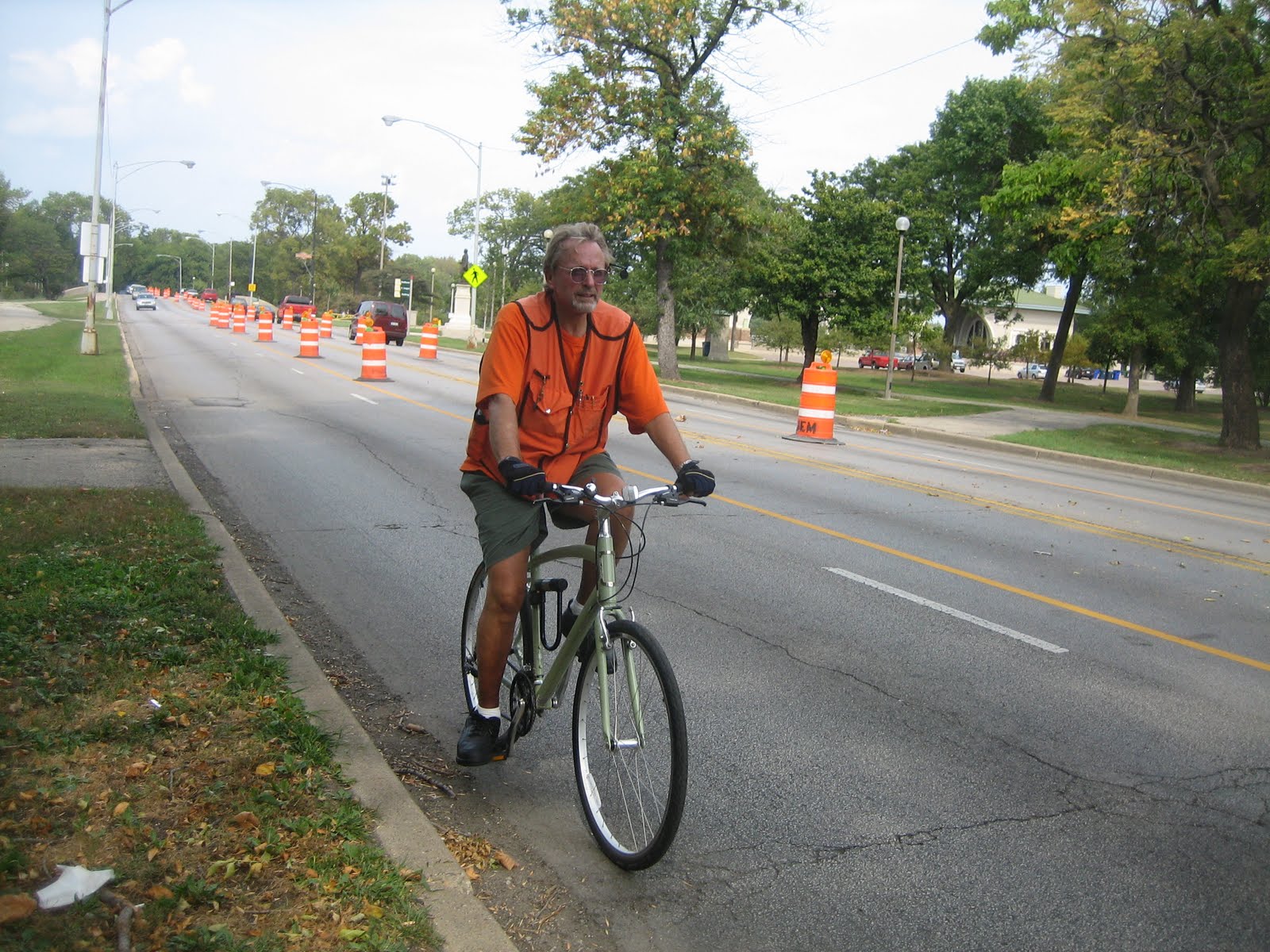
The road diet pilot in Humboldt Park (posed photo)

New “road diets” aim to beef up safety by slimming down streets, but will bicyclists get their piece of the pie?

by John Greenfield

[This article also appears in Time Out Chicago magazine, www.timeoutchicago.com.]

Cities across the country are seeking to improve safety through the so-called road diet—narrowing or removing street lanes to calm traffic and create more space for pedestrians and bicyclists. “A major benefit is reducing vehicle speeds and focusing attention on the other public-way uses,” says Chicago Department of Transportation (CDOT) spokesman Brian Steele.

Now the city is planning to give Lawrence Avenue in Lincoln Square and Humboldt Drive through Humboldt Park a traffic tummy tuck. “It’s a shift in the way [the city is] thinking about streets,” says Active Transportation Alliance’s Adolfo Hernandez. “The aldermen for both projects have been very supportive. Taking away a lane of traffic is not easy to do—it takes political will.”

The $12 million Lawrence streetscape project, tentatively scheduled to start next year, stretches between Western and Ashland Avenues and will slim the avenue from its current four travel lanes to one lane in each direction with a center turn lane, Steele says. This “four-to-three conversion” will provide space for wider sidewalks, curb bump-outs, pedestrian refuge islands and new bike lanes.

This is what Lawrence currently looks like.

This is what Lawrence will look like after the road diet is implemented.

The streetscape also will provide more space for sidewalk cafés and make it easier to pedal to the lake, says Dan Luna, 47th Ward chief of staff. “Lots of people have been contacting our offices requesting safer bike routes,” he says.

Eric Holm, manager of On the Route Bicycles (2338 W Lawrence Ave), applauds the change. “Lawrence is pretty intimidating for beginning riders,” he says. “Adding bike lanes means more people will be riding past our store and shopping here.”

The Humboldt Park road diet is proving to be a bit more controversial. Since August 23, CDOT has been working on Humboldt Drive from North Avenue to Division Street, the high-speed roadway dividing Humboldt Park. It temporarily changes the four-lane street into two travel lanes with a center lane used as a combination left-turn lane and pedestrian refuge area, using orange traffic barrels to keep moving cars out of the center lane. After CDOT analyzes the effects on traffic speed and behavior, Steele says, the changes may become permanent next year.

Roberto Maldonado, 26th Ward alderman, helped push for the project after his office received many complaints about speeding traffic and difficulty crossing the street, says Maldonado’s chief of staff, Kathleen Oskandy. “A lot of them were from young moms with baby strollers,” she says. Although residents proposed adding stoplights, stop signs and speed humps, Oskandy says federal constraints on the historic boulevard limited those options.

Not everyone is enthusiastic about the experimental setup, which, unlike the Lawrence road diet, does not include the addition of bike lanes. Oskandy says there was initial talk of including them, “but the first plan of attack was to slow down the traffic, so bike lanes might have added to the confusion.”

Drivers we talked to felt comfortable with the new configuration, but cyclists didn’t. During a half-hour period on a recent Tuesday afternoon, a handful pedaled on the asphalt paths that run parallel to Humboldt Drive, but no one attempted to ride in the newly slimmed street. “I’m a little afraid to bike in the street now,” said Jim Stablein, 58. “Cars can’t squeeze by you.”

Jim Stablein (posed photo)

Although the city-issued Chicago Bike Map designated this segment of Humboldt Drive for years as a cycling-friendly street, CDOT removed it from this year’s edition, recommending a stretch of nearby Kedzie Avenue as the safer route. As a result, the two-mile stretch of Humboldt (called Sacramento Boulevard south of the park) between Armitage Avenue and Franklin Boulevard is virtually the only segment of Chicago's 28-mile historic boulevard system that is not recommended as a bike route. Since Humbolt is no longer a recommended route, it's not under consideration for bike lanes, says CDOT bikeways engineer David Gleason.

That’s unfortunate, says Todd Gee, president of the nonprofit alt-transportation org Break the Gridlock. “The new travel lanes aren’t wide enough for cars to safely pass bicyclists. It’s fantastic they’re doing something about speeding and making it more pedestrian friendly, but it’s disappointing that they’re not accommodating bikes.”

Ash Lottes, who takes her son to pre-school by bike via the park, says she met with Maldonado on September 21 to discuss the possibility of adding bike lanes and sidewalks along Humboldt. She provided the alderman with blueprints for alternate street configurations that would include bike lanes.

“He told me that he has no intention of adding a bicycle lane or any other accouterments on that stretch because ‘the road is too dangerous for pedestrians,’” she says. Lottes recently posted on the local bike website thechainlink.org, asking members to lobby Maldonado for bike lanes on Humboldt. “To me the road seems too dangerous for pedestrians because there are no sidewalks, crosswalks or bike lanes.”

Thursday, February 18, 2010

CTA riders sound off on cuts to the #52 bus


By John Greenfield

[This article also runs in theis week's Time Out Chicago magazine, http://timeoutchicago.com.]

Curious about how the new CTA service cuts are impacting Chicagoans, on Monday, February 8, the day after the cuts took effect, I traced part of the #52 Kedzie/California route by bicycle and talked with people waiting for, missing, and grumbling about, the bus.

The #52 winds from the “Little Arabia” strip at 63rd Street and Kedzie Avenue to Hot Doug’s at California Avenue and Roscoe Street. Before the CTA belt-tightening measures—cuts of nine express buses, reduced service hours on 41 bus routes, and less-frequent service on 119 buses and seven of the eight rail lines—the 52 operated from about 3:30am to 12:30am on weekdays. Now weekday service starts about a half hour later and ends as much as 40 minutes earlier, with up to a ten-minute longer wait time between buses.

As I pedal south on California from Logan Square around 10:00 pm, then west on Chicago and south on Kedzie into Garfield Park, I cross paths with a couple of northbound buses but don’t see anyone waiting at the stops.

Around 10:30 pm outside the shuttered 007 Lounge, 600 N. Kedzie, with its James Bond-esque logo, a middle-aged woman in a hoodie says the earlier end time means she won’t have a ride home from late shifts at her nursing home job. “I think it’s crap,” she spits.


A few blocks south by the Green Line’s Kedzie station, Harry Lucas and Jesse Galloway are waiting for the southbound bus, the last leg of their trip home from their bricklaying class at Bronzeville’s Dawson Technical Institute. They tell me the cuts mean that if class runs late—which it occasionally does—they’ll miss their ride home.


“You used to wait 10 or 15 minutes between buses,” Galloway says. “Last night it took a half hour. It’s messed up. The CTA and the drivers need to stop pointing fingers and come up with a solution.”

Rolling south through Lawndale and into Little Village I pass two or three more northbound buses, then stop into George’s Hotdogs, an old-school stand at 2612 S. Kedzie. Owner George Maichalios, nattily dressed in a fedora and tweed jacket with a handlebar moustache, says the cuts aren’t a problem for his employees since only his wife and son work the grills.


But Malcolm X College student Michael Alaniz looks depressed as he waits for his burger. He’s used catching the bus home from the Pink Line’s Kedzie stop after classes but he just missed the last southbound #52 which left 26th Street at 11:11 pm. “Now I’ll have no choice but to walk thirteen blocks,” he says. “This sucks. It was hard enough to get to work and school by the CTA before. This just makes it harder.”

As I spin northbound again the bus stops are deserted. Around midnight I stop to talk to three homeless guys outside Anna’s Food and Liquors, 1303 S. Kedzie in Lawndale. A car pulls up and a young man who looks like 50 Cent gets out. “What is this - some undercover shit?” he says and threatens to kick my ass. After he enters the store I follow the homeless guys’ advice and get back on my bike. Note-to-self: don’t conduct interviews outside liquor stores late at night.


I follow the bus route back to the Continental, a 4 am bar at 2801 W. Chicago in Humboldt Park. As Wire’s “Pink Flag” blasts on the sound system, doorman Jason Holshoe says he used to catch the first #52 of the morning home after work. Now that the bus starts later he’ll spring for a cab rather than wait.


“We’re getting less frequent service but still paying the same fare,” Holshoe says. “It’s less bang for your buck. And why did they have to make the cuts in the dead of winter? If it was summer at least you wouldn’t be waiting out in the cold.”

Bellying up at the California Clipper, 1002 N California Ave., I alert barmaid Michelle Tomlison that the 52 has stopped running for the night. She offers a customer one for the road. “Nah, I’m already at the point where I probably shouldn’t drive,” he says. “Well,” Tomlison says with a wink, “maybe you should take the California bus.”

Wednesday, February 3, 2010

Ciclo Urbano opens on Paseo Boricua


by John Greenfield

After five years of operating out of the back of a storefront near North and Western, in May West Town Bikes community cycle center moved to a new larger space at 2459 W. Division on Humboldt Park’s Paseo Boricua Puerto Rican business district. Founded by Alex Wilson, West Town is a not-for-profit which teaches bicycle safety and maintenance, and other life skills to youth, as well as providing open shop sessions and mechanics classes for adults.

Partnering with the Puerto Rican Cultural Center and the Division Street Business Development Association, West Town is launching a new retail store called Ciclo Urbano (“Urban Cycle”) at the front of the space, offering used bikes, basic commuter gear and repair services. In cooperation with the cultural center and its community center Batey Urbano (“Urban Gathering-Place,”) the shop will host programs for underserved youth, teaching mechanical and entrepreneurial skills and offering opportunities for creativity and adventure through bike building and travel.


A grand opening celebration and fundraiser took place on Friday, May 1, starting with a parade leaving from the old space, 2418 W. North, to a block party at the new one, departing around 5 pm. The festivities included live music; Puerto Rican cuisine; and beer from New Belgium Brewery, whose Tour De Fat bike festival raised several thousand dollars last year for West Town, making the expansion possible.


Recently Vote With Your Feet met with José “Jay” Rivera, a Columbia College film student who volunteers at Batey Urbano, and José Luis Rodríguez, Program Director for the cultural center’s CO-OP Humboldt Park obesity prevention initiative, at Café Colao, 2638 W. Division. They talked about how their organizations promote a healthy community and the significance of the new shop to the neighborhood.


José "Jay" Rivera and José Luis Rodríguez in front of the new Ciclo Urbano space

VWYF: Jay, how’d you get involved with West Town Bikes and Ciclo Urbano?

Rivera: When I graduated high school my sister got me a bike and I rode it every day. It was just one of those bikes you get from a department store like a Wal-Mart or something and it started to break down on me. One of my roommates had an old Schwinn Suburban so I put new tires on it and started riding that, to school and along the lake. When that started breaking down I tried to fix the small things.

CO-Op already has a program called Muévete (“Move Yourself,”) with free dancing and aerobics classes at the Humboldt Park Field House. There was a conversation about me maybe joining Muévete and adding a bicycling component since I was riding every day instead of taking the bus. Also Co-Op sponsored a fresh fruit market called Conuco on Saturdays and Alex Wilson used to sell bicycles there. I met him when I bought a bike from him. I got involved in the Build A Bike workshops at West Town and a year and a half later there was talk of bringing a shop to Division Street and they asked if I was interested in helping out.

VWYF: José [Luis Rodríguez,] why is obesity a problem in Humboldt Park?

Rodriguez: Among the Latino population in Humboldt Park, both Puerto Rican and Mexicano, the overweight and obesity rate is close to 50 percent among the young, between the ages of two and 18, and the adult population runs at around 32 percent. This can be attributed to a number of things. One of them is the lack of physical activity. Kids don’t get out as often as they should. They’re not engaged in sports activities, they’re not engaged in riding or walking in the neighborhood. They’re much more sedentary.

And this happens across the population as a whole – it isn’t something new. But this impacts us specifically because one half of the young population has a problem that will eventually lead to something much greater. The diabetes rate among Puerto Ricans in Humboldt Park is 21 percent – that’s very high. The mortality rate is 68 deaths per every 100,000. Obviously there are a lot of other factors that lead to diabetes but obesity is certainly one of them.

CO-OP Humboldt Park came about after a study by Sinai Urban Health Institute which looked at six community areas and their rates of obesity among children and adults. That study was followed up by a survey that we did at one of our street festivals called Fiesta Boricua. From that survey we held a community meeting with the support of a local church. From that we began looking at the issue of obesity as a problem that needed to be addressed.

And this is where Muévete comes in, in terms of providing a space and a place free of charge where residents who are overweight or obese can go and exercise. We have a really good participation rate with 40 to 45 participants at every one-hour session who are getting aerobic activity. It’s low-impact aerobics, it’s not designed for folks that are already physically fit. It’s really for community residents that are not doing anything at all, so they can go somewhere and see other people that look like them and have the same issues. They can begin taking charge of their own health.

That’s part of the physical activity component but we’ve always said that physical activity is not just aerobics. Over the summer we started a walking program five days a week and we saw biking as another component. So there are five or six activities that we want to promote and get community residents involved with - aerobics, walking, biking, swimming and skateboarding – so we can get the entire community involved in some kind of physical activity. The young are more in tune with skateboarding and biking.

So for us as CO-OP our thing is that we have a problem and we have to address it and try to figure out what can be done. It’s not enough to say, “Go to the doctor.” It’s not enough to say, “Go on a diet.” There are a lot of other things that are involved. We have to capture people’s imagination and engage them in such a way that that they take ownership of the things we do.

So biking is something that can involve more young people and capture their imagination. It addresses health issues, but also environmental issues. With all the talk of reducing our carbon footprint … I’m 48 years old and when I was growing up we didn’t have computers or Nintendo. I can remember, six, seven days a week we were riding bikes, playing baseball, playing basketball, playing “Catch One Catch All.” Today most young people don’t do any of this. So the whole idea is to give young people something healthy and constructive to do.

VWYF: Jay, tell me about Batey Urbano.

Rivera: The Batey is about seven years old and I’ve been with it three years, since I started high school in this neighborhood. It was started by a group of young college students that felt that there was no place in the community where kids of color could channel their energy into something positive. There wasn’t a particular idea of what the space would be it was like, “OK, we have money for the first month’s rent and for the sign – what do we do with it?” Nowadays we’re funded by grants and donations.

One of the things that make the Batey unique is that it’s run by a collective of youth. There’s no board or anything. On any given Friday there’ll be a hip-hop night where young people come out and do their stuff or people from other cities come and perform. There are poetry nights and film nights, where we watch a film and discuss it. There are also nights when we bring professors in for teach-ins.

During the week we have classes called BACCA, Barrio Arts, Culture and Community Academy. In that we teach on-line radio and have our own station, radiobatey.org. [The website currently is down as they change servers.] We also have classes in photography, journalism and graphic design. Right now we’re working on a campaign against underage drinking and using all the different media that we’ve taught the students to try to figure out how to reach the community with flyers, advertisements and radio spots. We’re moving towards having video labs and teaching film.

One thing we’ve had since the Batey opened is a policy of no racist, sexist, homophobic language in the space. It’s a way to question the way that we speak to each other and how we treat each other and how do we turn the Batey into a safe space where people can express themselves creatively.

VWYF: How is Ciclo Urbano going to be a valuable addition to the Paseo Boricua?

Rivera: A lot of people in the neighborhood associate bicycling with yuppies but Ciclo Urbano is going to change that perception. Service is going to be available in Spanish or English. The shop is going to provide bicycles and gear to the community at reasonable prices. For example, it will be the first shop in the city to sell used tires and patched tubes. In an emergency you’ll be able to pay three dollars for a tire that will keep your bike rolling. This also cuts down on waste and has an environmental impact.

Alex Wilson leads West Town Bikes students on a ride

They’re going to offer cheap or free Build A Bike classes for young people. And young people are going to have a voice in what kind of other programs they would like to see. There’s talk right now of a bike-sharing program – those details are still being worked out. There will be opportunities for jobs and internships for kids who complete the youth programs.

Rodriguez: The relationship between West Town Bikes and the community has been wonderful because West Town has approached this in a very mindful and respectful way. Puerto Ricans have been in the neighborhood since the ‘50s, after being displaced from other parts of the city. There are historical markers here and the flag arches over Division Street, but some people move into the neighborhood and they’re clueless.

Ciclo Urbano was a case where someone approached us and said, “How can we work together to do something mutually beneficial?” Alex Wilson and West Town did a presentation for the board of the Division Street Business Association explaining how in the future the shop would represent the community in terms of staff and programming. The board voted overwhelmingly in favor of his proposal and the DSBA actually wound up moving offices so that Ciclo Urbano could have a corner space. This isn’t going to be just another bike shop – it’s going to be a model for how to put together a business that’s culturally relevant.