Showing posts with label ciclovia. Show all posts

Friday, December 3, 2010

Why Chicago is falling behind other bike towns

CDOT Commissioner Bobby Ware speaks at the Bike to Work rally

By John Greenfield

[This piece also runs in this week's Newcity, www.newcity.com.]

Don’t get me wrong – Chicago’s already a terrific place to ride a bicycle. It’s flat, with a bike-friendly street grid and a scenic, 18.5-mile Lakefront Trail. Since the early ‘90s, the City of Chicago has spent $100 million to push pedaling, striping over 110 miles of bike lanes, installing more than 12,000 bike parking racks, and educating tens of thousands people about safe cycling via Mayor Daley’s Bicycling Ambassadors. Cyclists have access to buses and trains, we’ve got a fancy bike station in Millennium Park, and the list goes on.


But when Newcity asked me, a former Active Transportation Alliance staffer and consultant to the Chicago Department of Transportation’s (CDOT) Bicycle Program, for my take on the current state of bike culture in Chicago, one word sprang to mind: stagnant.

On some levels things are going great. Since changing its name from the Chicagoland Bicycle Federation, Active Trans has been doing yeoman’s work building a coalition of biking, walking and transit interests. This has helped double the organization’s budget and staff size, increasing its clout to promote healthy, environmentally-friendly travel.

We now have four community bike centers spread from Woodlawn to Rogers Park, most teaching bike handling and mechanical skills to inner-city youth and selling refurbished rides to residents for cheap, green transportation. Three of these co-ops have expanded to larger digs in the last year or so.

Students and staff at Blackstone Bicycle Works in Woodlawn

There are now three Euro-style bicycle shops selling stylish, practical city bikes and cargo cycles, plus a gaggle of other new stores serving the ever-expanding ranks of daily commuters. After all, CDOT says bike traffic has quadrupled on Milwaukee Avenue over the last six years.

The Chainlink, a social networking site for Chicago cyclists, has ballooned to almost 4,000 members in just two years. There are now a multitude of two-wheeled subcultures in this city, some of which I’ve probably never even heard of. Why, only yesterday I heard the term “Tarck-ing” (fixed-gear, freestyle trick riding) for the first time.

But lately CDOT and other City agencies have been spinning their wheels when it comes to making bicycling safer, more convenient and fun through innovative bike facilities and programming. To paraphrase Daniel Burnham, they’ve been making little plans that have no magic to stir cyclists’ blood.

I’m not the only one who thinks so. Executive Director Rob Sadowsky recently resigned from Active Trans to take the reigns of the Bicycle Transportation Alliance in bike-crazy Portland, OR. Since Active Trans gets much of its funding from consulting contracts with CDOT, the nonprofit tends to be muted in its criticism of City Hall. Freed from this constraint. Sadowsky fired a parting shot in a recent Sun Times interview:

"Chicago was leading the way for a long while in cycling," Sadowsky said. "Things have been happening in other cities, like Minneapolis and New York, that really made strides we're not even coming close to. Part of that is a strong presence from the Department of Transportation's commissioner level and strong backing from the mayor. We're kind of lacking that in the city right now."

This current leadership vacuum was apparent at this year’s lackluster Bike to Work Rally. Mayor Daley, who usually shows up to give an enthusiastic if somewhat cryptic speech at the annual rally, was conspicuous by his absence.

Mayor Daley at a previous Bike to Work Day rally

CDOT Commissioner Bobby Ware, subbing for the mayor, seemed to know little about his agency’s bike projects. He spoke with his nose in his notes, referred to the City’s Bike 2015 Plan blueprint for cycling as the “2010 Plan,” and mangled the name of a Bicycle Program staffer who accepted an award on behalf of the program.

In fairness, Ware’s only been on the job for a month. But the fact that CDOT has had five commissioners in six years, for reasons known only to Mayor Daley, has slowed the pace of bicycle planning. Each new commish has to be brought up to speed on cycling issues, and this wastes precious time.

Another speed bump to better bike facilities and events has been the City’s reluctance to put some skin in the game. Daley, rumored to be a cyclist himself, is often cited as the U.S. mayor who is most outspoken in support of biking. And as a powerful politician, his lip service is in fact crucial for motivating bureaucrats to support bicycle projects.

But like our under-funded transit system, bicycling gets almost no money from the City budget. Virtually all of the cash CDOT spends on bike initiatives comes from federal and state funds, often through federal Congestion Mitigation and Air Quality grants which come from a tax on gasoline.

This stinginess makes it harder to pull off bold schemes like the “ciclovia,” an event that shuts down several miles of streets to cars, creating safe places to bike, walk and socialize. Active Trans first proposed bringing this Latin American concept to Chicago in the early 2000s, well before other U.S. cities were talking about it. But City Hall’s insistence on a heavy police presence and reluctance to foot the bill delayed the program for years while Active Trans struggled to raise the necessary funds.

Chicago's "Open Streets" ciclovia

The ciclovia finally debuted in 2008 as “Sunday Parkways” with events on two different 3.5-mile courses on Sundays in the fall. In 2009 it was consolidated to one 7-mile summer Saturday event, called “Open Streets.” After these modest successes the program fizzled out due to the difficulty of funding it - there will be no major events in Chicago in 2010. Meanwhile, city-funded ciclovias have flourished in other cities. New York is staging three this year, Portland, OR, is staging five, and San Francisco is staging nine.

San Francisco's "Sunday Streets" ciclovia

Chicago used to be the poster child for big-city bike improvements. A few years ago, New York’s Transportation Alternatives advocacy group liked to use the Second City’s successes to shame the then-sluggish New York DOT into action. But things changed in 2007 when New York got a dynamic, bike-friendly new transportation commissioner, Janette Sadik-Khan. In recent years Chicago has fallen behind New York and many other cities in several aspects of promoting cycling.

Chicago has installed more bike racks than any other U.S. city. But last year the City began uprooting most of Chicago's parking meters to make way for pay-and-display units, eliminating tens of thousands of de facto bike parking spots. Meanwhile, CDOT has not installed any new bike racks for months and will not be doing so anytime soon, due to installation contract delays.

Bikes crowded on racks and poles in Logan Square after meter removal

On-street bike parking, where a single car parking space is filled with racks to accommodate a dozen cycles, reducing sidewalk clutter and advertising the space efficiency of bikes, is beginning to be commonplace in Portland, OR, and San Francisco. Although Andersonville’s Cheetah Gym, with the blessing of the local chamber of commerce, asked for on-street racks several years ago, CDOT passed on this opportunity, citing concerns about safety. Chicago still hasn’t tried on-street bike parking.

On-street bike parking in Portland, OR

Millennium Park’s $3 million, state-of-the-art bike station opened to fanfare in 2004, but the facility is too far east to be of much use to most Loop commuters. The Bike 2015 Plan calls for building a second bike station in the West Loop, near Union Station and the Ogilvie Center, so that Metra commuters could pick up bikes to pedal to their offices. Although space was available to build the station in Metra’s new French Market, next to the Ogilvie Center, CDOT missed the boat on this opportunity as well.

Millennium Park's bike station

Separated bikeways, where cyclists are protected from cars by a curb or other physical barrier, are widespread in Europe and are becoming more common in U.S. cities. New York’s separated bike lane on 9th Avenue, for example, has been a hugely popular experiment, but Chicago has yet to try this idea.

Separated bike lane on 9th Avenue in New York City

Automated bike rental has been commonplace in Europe for years. Paris’ Velib system, with 20,000 bikes at rental kiosks all over town, is credited with doubling the mode share for cycling. Chicago has been talking about this idea for years and in 2007 Mayor Daley rode a Velib bike in Paris. But Washington D.C. beat us to the punch two years ago, Denver now has 500 automated rental bikes, and Minneapolis will be getting 1,000 this summer. Chicago is finally piloting a bike-share program this July, but once again we’re thinking small, with only 100 bikes in six Loop locations.

Denver's B-Cycle automated bike rental kiosks

But perhaps the most frustrating example of Chicago being the first to come up with a good idea for cycling but the last to implement it is the Bloomingdale Trail. As early as 1997 planners proposed turning the little-used Bloomingdale elevated rail line on the Near-Northwest Side into a multi-use path, in 1997, and the Chicago Plan Commission committed to the idea in 2004.

Although the rugged, now-abandoned rail bed is already getting plenty of illegal use from cyclists, joggers and squatters, the City seems to be dragging its heels on renovating the structure and opening it to the public. It’s unlikely to open until the end of this decade. Meanwhile, New York’s elegant High Line “vertical park,” a similar project that wasn’t officially proposed until 1999, debuted last year to huge acclaim – it’s already had millions of visitors.
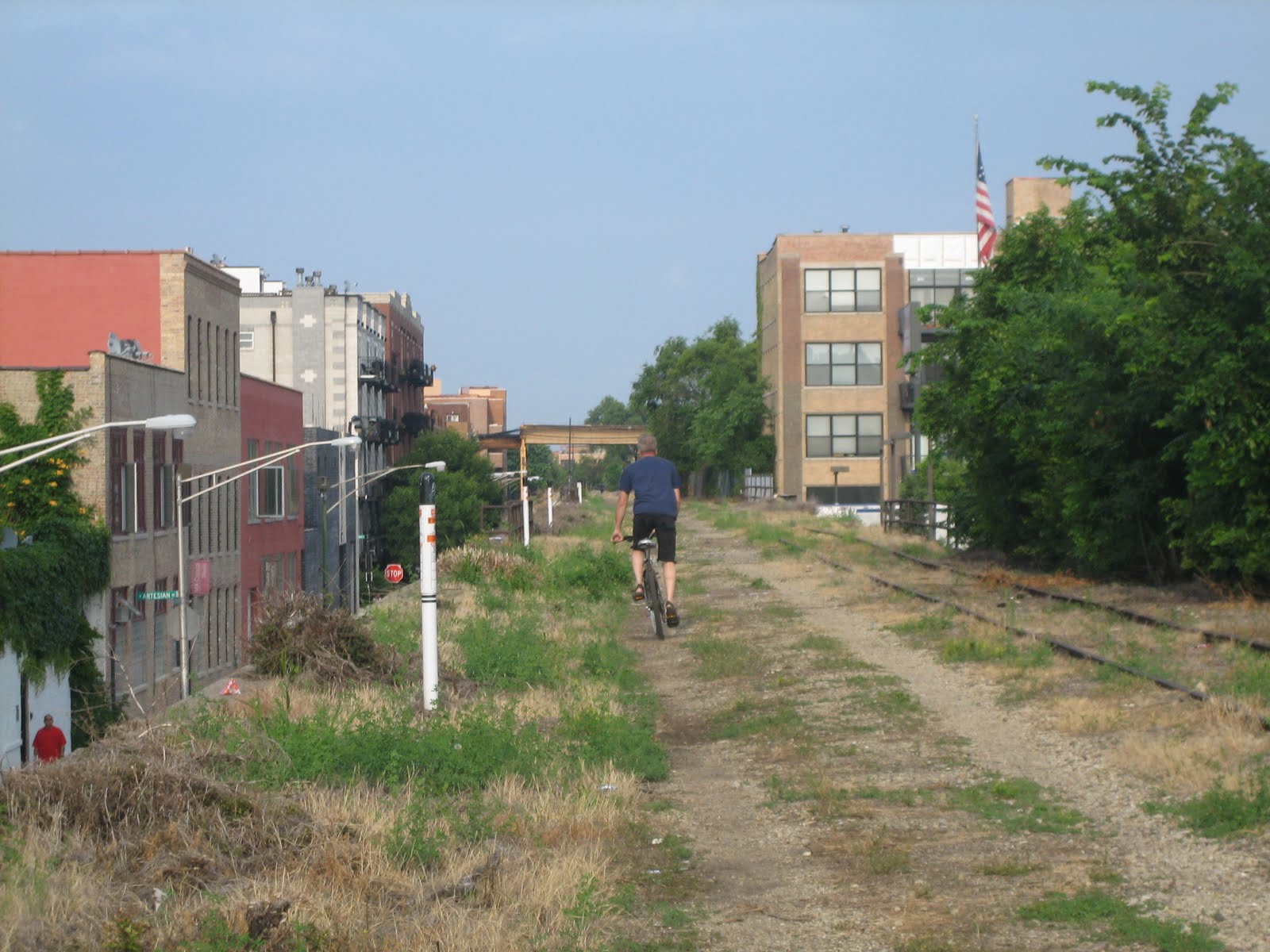
Chicago's Bloomingdale Line

New York City's High Line

As a follower, not a leader, in all these different categories, it’s no wonder Chicago dropped in Bicycling magazine’s ranking of the best large U.S. cities for biking, from first place in 2001, to tenth place in 2010. It’s not that things are bad here, it’s just that more exciting stuff is happening more quickly elsewhere.

Active Trans will be hiring a new director soon, and it will be interesting to see if this person will can light a fire under CDOT and other departments to make some of the above projects happen sooner than later. But again, Active Trans can only push so hard, because the advocacy group depends on the City for consulting dollars.

Unlike in liberal, temperate West-Coast cities where bicycling has long been popular and politicians have responded to demands from the public for better bike facilities, cycling in Chicago has traditionally been a “top-down” affair. Under Daley, the City has installed paths, lanes and racks in an effort to coax people out of their cars.

But now that Chicago cycling has gained momentum while CDOT’s bike initiatives have lost steam, it’s time for a “bottom-up” approach. Citizens need to start pressuring City Hall to put the metal to the pedal.

It’s worked before. After seriously injuring herself when she wiped out on one of Chicago’s dangerous metal-grate bridges, in 2002 Kathy Schubert launched a letter-writing campaign demanding that the bridges be made safer for cyclists. The campaign infuriated then-CDOT Commissioner Miguel d’Escoto, but after receiving dozens of postcards, he ordered the Bicycle Program to start working on the problem. Eventually metal plates were installed on bridges at Wells and Cortland.

The Bike 2015 Plan, released in 2006, calls for the establishment of ten miles of “bike boulevards,” traffic-calmed, residential streets where cycling is encouraged because cars are forced to slow down, common in Portland, OR, Berkeley, CA, and other cities. Last fall Sarah Kaplan grew frustrated that little action had been taken on this proposal. She formed the grassroots group Bike Boulevards Now! to lobby the city to get moving on the idea. CDOT Bicycle Program Coordinator Ben Gomberg now says he’s hoping to establish Chicago’s first bike boulevard by 2011.

Bike boulevard in Berkeley, CA

If you want Chicago to remain a first-class bicycling town, contact your alderman, CDOT, or the Mayor’s Office to demand that the City starts implementing big plans for biking - now. Tell them you want immediate action on exciting projects like separated bikeways, on-street bike racks, a new bike station, a large-scale bike-share program, City-funded ciclovias and the Bloomingdale Trail. Or, better yet, form your own grassroots, recruit members via the Chainlink, and start organizing for change. It’s time to put the rubber on the road.

Wednesday, October 1, 2008

New York's Summer Streets: lessons for Chicago


by John Greenfield

For years now New York City has looked to Chicago as the model for big-city bicycling improvements. For example, New York, with almost three times the population, has installed only a fraction of the number of bike parking racks our city has, and when NYC adopted our theft-resistant, square-tube racks they called them “Chicago Racks.” We’ve also had them beat in terms of miles of bike lanes proportionate to city size, education and outreach programs, and other metrics.

So it’s ironic that New York beat us to the punch this month by staging three ambitious, highly successful ciclovia events, called “Summer Streets,” with only a few months of planning. Meanwhile, after years of fundraising and negotiations between the Chicagoland Bicycle Federation, the City and community members, Chicago is finally getting around to staging Sunday Parkways on only two days in mid-fall, October 5th and 26th, on compromised routes.


As VWYF readers know, the ciclovia movement began in Bogota, Columbia, where for decades residents have been biking, walking, skating and hanging out on a network of largely car-free streets on Sundays. Nowadays the events regularly draw over 1.5 million people to recreate on a 70-mile route each weekend. This year ciclovias have begun to take off in the U.S. In addition to Chicago and New York, Portland, OR, staged a wildly popular event, also called Sunday Parkways, on June 22 and San Francisco will be holding “Sunday Streets” on August 31st and September 14.

Despite the efforts of the hard-working staff of the bike federation and other boosters since 2003, Chicago’s Sunday Parkways promises to be the least inspiring of the bunch. Our two ciclovias, bankrolled by the CBF via grants, will be taking place after peak bicycling season, on two separate 3.5-mile routes through neigborhoods a few miles away from the city center. The South Side route includes many blocks of gritty, treeless terrain and a half-mile that hugs the Eisenhower Expressway. The events will be far from car-free: autos will be driving on service roads parallel to most of route and in some cases four out of six travel lanes on the boulevards will have cars on them.


Contrast this with the three Summer Streets events that took place during prime cycling season on a 6.9-mile route through the heart of Manhattan. The route went from Central Park to the Brooklyn Bridge, along Park Ave. and Lexington Ave., through some of the most densely populated neighborhoods in the country. As in other cities with successful ciclovias, expenses were largely covered by the city government, in this case the NYC Department of Transportation. Best of all, motor vehicles were almost completely banned from the route.

I traveled to New York last weekend to check out the third and final run of Summer Streets firsthand on Saturday, August 23. When I joined the route on foot at 14th St. at 10 am the weather was lovely and the streets were packed with smiling people, mostly cyclists with a few walkers, joggers and skaters.


Police officers and traffic aides were directing motorized traffic on the cross streets while yellow-shirted volunteers held up signs reminding non-motorized traffic to be prepared to stop at the intersections. The volunteers I spoke with said they’d had no problems with participants disobeying traffic signals.

Heading south on Lexington, I soon met up with my friends Michael and Shenglan and their two-year-old daughter Altai, who was pushing a toy stroller. “We’re walking in the middle of the street,” cried Michael. “There’s throngs here, Altai, throngs!”


As we continued down Lexington we encountered an aerobics demo in front of a gym, a kids area with games and chalk drawing, and a live music stage featuring an opera singer, then a funky cello player. Other scheduled events along the route included African and salsa dancing, double-dutch jump-roping, yoga, bike handling classes, break-dancing, akido and a “hackey sack zone.” It was a vibrant scene.

At an info tent for Transportation Alternatives, NYC’s advocates for biking, walking and transit, who spearheaded the event, I asked deputy director Noah Budnick to explain the New York / Chicago role reversal. How was his city able to pull off such a daring, successful event in a few months while the Chicagoland Bicycle Federation labored for so long and faced so many roadblocks?

TA's Noah Budnick

New York’s achievement is particularly striking since bike planning was fairly dysfunctional there only a few years ago. When NYC DOT’s bike director Andrew Vesselinovitch resigned in 2006 he sent a letter to colleagues, reprinted in
the New York Times, savaging then-commissioner Iris Weinshall for shooting down half of his proposals for new bike lanes. Budnick gives a lot of credit for Summer Streets to the DOT’s progressive new commissioner, Janette Sadik-Khan who took over in 2007. “This absolutely wouldn’t have happened without her,” he said.

Budnick called New York’s political situation last year a “perfect storm” – ideal conditions for proposing an ambitious green transportation initiative. Along with the arrival of the new commissioner, Mayor Michael Bloomberg announced PlaNYC, his environmental sustainability plan which included targets for bicycling improvements and a proposal for congestion pricing. So when Transportation Alternatives brought up the idea of Summer Streets last winter, the City was all ears.

“The commissioner was completely committed to Summer Streets and Mayor Bloomberg said ‘Alright, let’s give this a try,’” Budnick reported. “I’ve heard the CBF has had a lot of resistance from the police but we had a police commissioner who wanted to proactively make this happen.”


Asked if he had any advice for Chicago and other cities planning ciclovias, Budnick said, “Whenever you try to do anything new in a city there are going to be people who will complain and give reasons not to do things, which is why it takes political leadership to make things happen.” Staging the events on Saturdays rather than Sundays in NYC avoided the resistance from churches which has led to delays and compromises in planning Chicago’s Sunday Parkways. The early hours for Summer Streets, 7 am to 1 pm, also minimized conflicts, said Budnick. “New York City’s not up before noon on Saturday,” he said.

As we spoke, a fire truck left a station along the route with its siren blaring but had no problem making its way to the cross street. “They could have said, ‘You can’t do this here because there’s a firehouse on this street,’” said Budnick. “But as you can see it’s actually easier for the truck to get through traffic when there are no cars.”

He urges cities like Chicago to make no small plans when staging ciclovias - “You can’t do this by half measures.” He added that the events should cover significant mileage, be completely car-free, and take place on consecutive weekends so that the attendance and community support can build. “Anything that waters it down sucks the energy out of it.”

Good news and bad news about Sunday Parkways

Central Park Ave., along the Oct. 26th Sunday Parkways route

By John Greenfield

I’m pleased to announce that Sunday Parkways, the Chicagoland Bicycle Federation’s proposal to create temporary space for non-motorized recreation along Chicago’s boulevard system, will become a reality this October 5th and 26th from 9 am to 1 pm. I’m less happy to break the news that the event will take place on fewer days, for less miles, with more car traffic and worse scenery, than originally hoped for.

Don’t get me wrong. Sunday Parkways is a terrific idea and I applaud the years of hard work by bike federation staff and others who did the planning, organizing and fundraising that has made this dream come true. I’ve written several articles over the years cheerleading the concept. I realize that compromises had to be made in order get approval for the event. But it’s a bummer that, due to factors beyond the CBF’s control, the original vision for the event has been watered down so much.

The CBF began plotting Sunday Parkways in 2003 after Chief Strategy Officer Randy Neufeld rode in Bogota, Columbia’s, Sunday Ciclovia. Since the 1980s, residents of that city have been coming out to play on a network of pedestrianized streets. Participants enjoy biking, jogging, pushing strollers, skating, doing aerobics and yoga, dancing to live music, or just hanging out with their neighbors in the car-free space. Nowadays the event takes place every Sunday on a 70-mile route, regularly drawing over 1.5 million participants.

Bogota's Sunday Ciclovia

The ciclovia movement has spread to other Latin American, European and Australian cities. Guadalajara, Mexico, in particular has been a model for the CBF, which invited Chicago clergy and community leaders on a fact-finding trip in spring 2007 to experience the city’s Via Recreativa firsthand.

That year El Paso, TX, pioneered the first ciclovia in the U.S., albeit with a total turnout of only 5,000 over four Sundays in May. On June 22 of this year, Portland, OR, debuted a much better attended event, beating out Chicago to be the first to use the “Sunday Parkways” moniker. New York City is also planning a ciclovia, called Summer Streets, on three Saturdays this month, liberating almost seven miles of Park Ave. from car traffic.

Portland's Sunday Parkways

Chicago’s initial proposal was to create a 7.5-mile route along the boulevards connecting three large green spaces on the city’s west side: Douglas, Garfield and Humboldt parks. The route would pass through the neighborhoods of Little Village, North Lawndale, Garfield Park, Humboldt Park and Logan Square. While cars were to be virtually banned from the boulevards, cross streets would still be open to motorized vehicles. Cyclists, walkers and skaters on the Sunday Parkways route would obey traffic signals to allow cross traffic to flow smoothly.

The plan was to run pilots on three summer Sundays. One Sunday the event would take place on the northern half of the boulevard route; on the second Sunday it would take place on the South Side; on the third Sunday the entire route would be used.

There were a few of years of near misses due to funding shortfalls and opposition from residents who felt alienated from the planning process and worried that church attendance would be hurt. But this year the federation managed to got a critical mass of community support behind the proposal, raised the $400,000 needed to stage the trial runs, and got final approval from the Mayor’s Office.

Unfortunately, the latest version of Chicago’s ciclovia is very different than the original vision. After I bicycled the final route, published on the federation’s website, I discussed Sunday Parkways with CBF Board Member Lucy Gomez, a Logan Square Neighborhood Assocation employee who is also co-chairing the Sunday Parkways community stakeholders committee.

Gomez says there had been some confusion among cyclists about the dates for Sunday Parkways. The bike federation had originally applied for permits to hold the event this August. Chicago Department of Transportation staff saw these dates on the permit application and posted them prematurely on CDOT’s bike webpage, she says. However, due to conflicts with other summer events, Sunday Parkways was pushed back to the middle of the fall.

Volunteer traffic aides at Bogota's Sunday Ciclovia

In Bogota and other ciclovia cities, traffic control is handled by volunteers, keeping costs low. But in Chicago, union requirements dictate that only paid police officers and Traffic Management Authority aides may be used to regulate motorized traffic. These City staffers will be bankrolled by the federation, rather than by public money, as was done in Portland. So, due to CBF budget constraints, this year’s pilot had to be reduced from three to only two Sundays. “In the ideal world we would have loved to have three dates,” Gomez says.

The October 5th event will take place north of the Garfield Park Conservatory; October 26th will take place south of the conservatory. Due to competing special events like Bears games this fall, there will be no date that unites the two halves of the Sunday Parkways route. “There wasn’t enough traffic management staff available for the whole 7.5 miles,” says Gomez.

The reduction from three to two dates could hurt Sunday Parkways chances of coming back in 2009. Earlier this year Gil Penalosa, Bogota’s former parks and recreation director and the international expert on the ciclovia movement, told me he encourages municipalities to try out the event on a few consecutive weekends to allow momentum and support to build. “The first Sunday is when people complain the most,” Penalosa said. “The second goes a lot more smoothly and the third is fantastic.”

Now, in Portland, a liberal West Coast city with more than three times the bicycle mode share of Chicago, it was relatively easy to get support for shutting down streets to create recreation space. It was a case of preaching to the converted. Even though it was held on a gloomy day, their first and only ciclovia was a runaway success.

Portland's Sunday Parkways

While bicycling has made big gains in Chicago in recent years, there’s bound to be a much steeper learning curve here. It’s likely that turnout will be relatively low the first time each of the two separate Chicago routes is piloted, particularly for the October 26th South Side event which includes several less-than-scenic streets.

With no second or third chance for word to spread and popularity to grow on each half of the route, drivers caught unaware by the road closures may grumble to their aldermen that they were inconvenienced for nothing. If there’s enough opposition, the event won’t return next year. This worst-case scenario is unlikely, but entirely possible.


Gomez talked me through the current route plans. Many Chicagoans have been picturing boulevards that are almost completely liberated from motorized traffic, where they and their families can recreate free of the sound, smell and danger of automobiles, but that won’t be the case this year. All the service roads (the smaller streets which parallel the central main drags of the boulevards) along the route will be open to car traffic during the ciclovia.

Service road along Humboldt Blvd.

Heading south from the northern terminus at the Logan Square Monument at Logan (2600 N.) and Kedzie (3200 W.), two of the four central travel lanes will be occupied by autos as well: one lane will be used for parallel parking for churchgoers and another lane will provide access to these parking spots. This is a concession to Logan Square clergy who had opposed Sunday Parkways early in the planning process, stalling it. Therefore, only two of the six total travel lanes (including the service roads) on Kedzie will be reserved for non-motorized uses, separated from auto traffic by barricades.

Logan Square Monument

“I don’t use the term ‘car-free’ to describe Sunday Parkways,” explains Gomez. “We say temporary closures of sections of the boulevards. We’re making some accommodations so people will have access. This is the case in Bogota and Guadalajara. It’s not uncommon that there’s some give and take for different reasons.”

As the route turns east onto Palmer Blvd. (2200 N.), cars will be allowed on the lanes north of Palmer Square Park and banned from the lanes south of the park to allow access to St. Sylvester Church at Palmer and Humboldt Blvd. (3000 W.)


Heading south on Humboldt the configuration will be the same as Kedzie, with only 1/3 of the travel lanes free of cars, until Bloomingdale Ave., (1800 N.) South of Bloomingdale cars will be banned from the central lanes of all the boulevards.

The route enters Humboldt Park at North Ave. (1600 N.) The park’s inner loop drive will remain open to motor vehicles, but cars will not be able to cross Humboldt Blvd. within the park. The course continues south to Franklin Blvd. (500 N.), then west to Central Park Ave. (3600 W.), heading the south through Garfield Park to the conservatory, the southern terminus of the October 5th route.
Humboldt Park

Despite all the car traffic, the scenery on this North Side route will be quite pleasant. But, as usual in Chicago, the South Side gets the short end of the stick. Only about six blocks of the October 26th event, whose northern terminus is the conservatory, takes place on boulevards. About a third of this route is on grittier streets that are not nearly as conducive to relaxed strolling or socializing. A half mile is on Harrison St. (600 S.), which butts up against I-290, the Eisenhower Expressway.


The CBF’s annual Boulevard Lakefront Tour bike ride uses Independence Blvd. (3800 W.) south of Garfield Park. But Gomez says crossing the Ike from Garfield Park at Independence was deemed too dangerous for Sunday Parkways due to the presence of expressway on- and off-ramps. Instead the route continues south from the conservatory on Central Park to cross 290.

From there, instead of taking Independence and Douglas Blvds. to get to Douglas Park, the route heads east along the noisy, smoggy Ike on Harrison (which is normally one-way east-bound but will be made two-way for the event.) It then turns south on Kedzie and east on Roosevelt (1200 S.) These are nearly tree-less, commercial streets that don’t lend themselves to ballgames, BBQ-ing or other positive forms of hanging out which the boulevards encourage.

Shuttered grocery store on Kedzie

From Roosevelt the route continues south down the western side of Douglas Park’s ring road, Sacramento Blvd. – the rest of the park will remain open to cars. The course continues south from the park on Marshall Blvd. (about 3000 W.), then east on 24th St. (also a boulevard) to the route’s southern terminus at 24th and California Ave. (2800 W.) in Little Village.

Douglas Park

Could the City have allowed Sunday Parkways to stay on the boulevard system by closing the Eisenhower Expressway ramps at Independence? Probably not, since the Interstates are under federal jurisdiction. “Getting on-and-off closures for the expressway system is always extremely difficult,” says CDOT spokesman Brian Steele.

Fair enough. But why was the nasty Harrison / Kedzie / Roosevelt detour chosen instead of having the route continue south from the Ike on much pleasanter Central Park, designated as a recommended route on the City’s bike map, then head east along lush Douglas Blvd. (1400 S.) to Douglas Park?

Via e-mail, CBF executive director Rob Sadowsky acknowledges that this is a good question but implies that the final say on the detour was out of the federation’s hands. “We worked with a retired commander of special events police to design the route in consultation with community representatives from each of the five neighborhoods,” he writes. “There were so many considerations taken into account including traffic management, specific sites of high levels of gang activity, access to hospitals and the expressway, and costs.”

“We all have ideas of pure boulevards,” adds Gomez. “But occasionally there’s obstacles we have to negotiate. In Bogota part of the route is along an expressway. It’s not pleasant but it gets you where you’re going.”

Despite the setbacks of fewer dates, less miles per event, more car traffic and a less scenic route than hoped for this year, Gomez says she has great expectations for the future of Sunday Parkways. “We have a vision that this will be successful and will happen more often in the future,” she says. “We don’t want this to be a one-time event, we want this to be a regular event.”

“This is going to be a great thing for Chicago,” she adds. “If you look at videos from Bogota and Portland you see people who are smiling and happy. Cars create a certain amount of stress in our lives, whether you’re a driver or a pedestrian. Sunday Parkways is going to make the boulevards feel like a happier place.”

I agree wholeheartedly. And I’ll keep my fingers crossed that Sunday Parkways will be back next year, bigger and better.

Thursday, May 1, 2008

The Car-free Parks Movement

Cities across the United States are creating more space for walking, running and biking by shutting down roads through parks and neighborhoods.

This article was originally published in the May 2008 issue of Parks and Recreation Magazine.

By John Greenfield

If the advocacy group Transportation Alternatives gets its way, 2008 will be the year New York banishes motor vehicles from Central Park and Prospect Park all summer long.

Nowadays, cars are only allowed on the parks’ perimeter roads during weekday rush hours and the holiday shopping season. But the group argues speeding autos still threaten the safety and serenity of the intended users: pedestrians, cyclists and others seeking a break from the city’s cacophony. “These parks are the crown jewels of New York and right now car traffic dictates how and when people can use them,” says TA spokesman Wiley Brown.

His group has collected over 100,000 signatures in support of its proposal for a car-free summer and the city’s new transportation commissioner says she’s thinking it over. Assuming this pilot program is successful, TA plans to push for banning autos altogether. “There’s so little time left for cars already it makes sense to just close the parks and be done with it,” says Brown. “We’ve reached a tipping point.”

New York’s proposal is part of a national trend to create safe, inviting places for exercise and relaxation by removing the sight, sound, smell and danger of car traffic. Dozens of cities have recently moved to restrict auto access to parks and other public spaces, according to Ben Welle from the Trust for Public Land’s Center for City Park Excellence in Washington D.C.

Others are planning ciclovia (“bike path”) programs in which networks of streets are temporarily closed to driving and open for non-motorized play. Last summer El Paso, TX, staged the first ciclovia in the U.S. and now Chicago, Philadelphia, Baltimore, Cleveland and Portland, OR, are working on similar events.

“Cities are beginning to reach a boiling point,” says Welle. “They realize that if all they do is plan around cars they’re not going to be healthy places for people. The obesity crisis, global warming and a migration of people back to the city are pushing this issue to the forefront. Residents want spaces that accommodate people rather than cars. We’re trying to put forward the idea that closing roads can revitalize parks.”

But proposals for road closures often meet stiff resistance from motorists and neighboring communities. They argue that traffic will become snarled, cars will be diverted onto residential streets, parking will suffer and shops and museum will lose patrons.

In 2003, for example, the National Park Service proposed expanding car-free hours on Beach Road in Washington D.C.’s Rock Creek Park, to weekday non-rush periods (it was already closed on weekends). Joggers and bicyclists were thrilled and the plan received overwhelming support at community meetings.

However, drivers and nearby residents rallied against the change, and local officials refused to back the plan. The park service abandoned the idea. “The commuters were able to garner more political support,” says park superintendent Adrienne Coleman. “There needs to be cooperation from the surrounding jurisdictions; otherwise its just not going to happen.”

Despite worries from residents, studies have shown that park road closures do not contribute to congestion or parking problems. In San Francisco, a 2007 report commissioned by the mayor found that car-free Sundays on John F. Kennedy Drive in Golden Gate Park, in place since the ‘60s, double the number of visitors with little effect on the adjacent neighborhoods. Patronage of the park’s De Young Museum and local businesses actually increases on Sundays.

The San Francisco Bike Coalition used this study to successfully lobby for “Healthy Saturdays” last summer, ending seven years of debate on the subject. “Golden Gate Park is a retreat from urban pressures,” says the coalition’s Leah Shahum. “It needs to be a safe, welcoming place. We wanted Saturdays to look like Sundays.”

Wiley Brown says the minimal affect park road closures have on congestion can be explained by what he calls “induced demand.” When you allow people to speed through parks, you give them an incentive to drive. “Some people think traffic is like water: if you block it from one place it will just go somewhere else. We’ve found that this is not true.” Instead, when roads are closed less people choose to drive, a phenomenon sometimes called “traffic evaporation.”

“I’m not really convinced,” says John Corlett from the American Automobile Association’s New York chapter. “Some of these advocacy groups have a results-oriented approach – ‘Let’s achieve the objective and worry about the impact later.” He says that AAA does not have a knee jerk reaction against closing park roads and he has heard no complaints from motorists about Central Park. But he argues there should be careful study before further closures take place. “The Department of Transportation moves cautiously and I know TA isn’t too happy with that but I understand the DOT’s reasoning.”

If local authorities can be convinced, Boston may be the next big city to remove autos from parkland. Across the Charles River in Cambridge, a 1.6-mile stretch of Memorial Drive along the north bank has been car-free on Sunday afternoons for over 30 years. The resulting greenway, is known as “Riverbend Park.”

In January, the Charles River Conservancy proposed opening a five-mile stretch of the westbound lane of Boston’s Storrow Drive, on the south bank of the river, to non-motorized uses on Sunday mornings. “We want to bring a sense of quietude to the river because right now it’s not as peaceful as it could be,” says the Conservancy’s Nicole Brown. Unlike Memorial, Storrow passes under the streets that intersect it. “The beauty of Storrow Drive is you could get a vigorous, uninterrupted five-mile workout.”

She’s optimistic that the state Department of Conservation and Resources, which owns the road, will eventually support the plan. “Car-free days are hot topics,” she says. “But when we’ve explained the hours and that people can still drive east into the city, people have generally gotten behind this.”

In Phoenix, the Parks and Recreation Department’s new “Silent Sundays” at South Mountain Park and Preserve bans autos from the road to the mountain’s summit once a month, all year ‘round. “It’s a bigger success each time we do it,” says park supervisor Kim Keith, adding that he’s received a lot of positive feedback via e-mail. “80% of the messages are from road bikers who use the road to get to the top of the mountain and like the fact they can relax and not worry about cars. The other 20% are from hikers who appreciate the clean air and quiet.”

The ciclovia model, already common in Latin America and Europe, is the wave of the future for road closures in North American cities. Bogota, Colombia, pioneered the concept in the ‘80s, creating a car-free street route where residents could not only run and bike but also push strollers, play volleyball, skateboard, dance, do aerobics and yoga or just hang out and enjoy the social environment. Today Bogata’s ciclovia takes place each Sunday on a 70-mile network, regularly drawing 1.5 million participants. Every February 1st is Dia Sin Carro, “Car-Free Day,” when private autos are completely barred from the city.

Gil Penalosa, Bogota’s former parks and recreation director, speaks passionately about how ciclovias promote health and a sense of community. “Ciclovia provides a wonderful opportunity to walk, bike and socialize. It’s magical because all of the sudden you are invited to occupy a space where you are normally forbidden.” He calls the event an “exercise in integration” which encourages folks from all walks of life to interact with people of different ages, backgrounds and economic levels.

The ciclovia model is cheap and flexible, Penalosa says. “It doesn’t cost you one cent in capital investment. It can be as successfully in huge cities as small towns. The main thing it requires is political will.” He suggests that municipalities should try it out for a few consecutive Sundays to allow momentum and support to build. “The first Sunday is when people complain the most, the second goes a lot more smoothly and the third is fantastic.”

Last year El Paso, a poor city with only about 25% of the green space of an average American town its size, became the first U.S. municipality to hold a ciclovia. Just across the Rio Grande in Ciudad Juarez, Mexico, car-free days had been drawing 60,000 participants on Sundays.

“Because Juarez was so close to us it wasn’t such a radical idea,” says Shamori Whitt, who coordinated the event for the west Texas town. “68% of the women in El Paso are overweight and 78% of the men, and 10% of the population has diabetes. You can’t really argue with those numbers.” The city was able to raise $100,000 in contributions, used mostly to pay police to manage intersections so the ciclovia would not affect cross traffic.

The event took place every Sunday in May on a linear route that included Scenic Drive, a mountain road with a breathtaking vista. “People said they never appreciated how beautiful the view was until they were able to get up there on a bike,” says Whitt. While many cyclists and bladers enjoyed the challenge, she suspects the steep grades intimidated others – there were only 5,000 total participants in this city of 700,000. Next year the ciclovia may be moved to flatter, more populated areas so more people can take part.

Despite the modest turnout Whitt says the ciclovia inspired her. “I was excited that people were getting to know their neighbors. Little kids were coming out of their houses to wave and we saw a lot of dogs out there. We had to set up water stations for animals next to the water fountains for people.”

At four times the population of El Paso, Chicago is proposing a ciclovia, called Sunday Parkways, which could draw much larger crowds this summer. No stranger to car-free events, every year the city hosts Bike the Drive. 15 miles of Lake Shore Drive, an 8-lane superhighway, are closed to traffic, drawing 20,000-plus cyclists. The Chicagoland Bicycle Federation is spearheading the Sunday Parkways effort and has raised much of the $400,000 needed to run three to five trials, pending approval from the mayor’s office.

The proposed 7.5-mile route uses the city’s historic boulevard system connecting three large parks on the west side of town, largely through low-income areas. In 2006 when the bike federation first pitched the idea it faced opposition from churches along the boulevards who felt alienated from the planning process and worried street closures would hurt church attendance. They complained to their alderman and the project was stalled.

In the spring of 2007 the federation invited church representatives and other community leaders on a fact-finding trip to Guadalajara, Mexico, to experience its ciclovia. Called Via Recreativa, “Recreational Path,” Guadajara’s event is a seven-mile route that draws up to 500,000 participants each weekend. It has brought a wave of customers to businesses that had previously been shuttered on Sundays.

Wowed by what they saw, including churches holding outdoor services along the route, the Chicago clergy decided to endorse Sunday Parkways. In turn, the bike federation agreed to move the proposed ciclovia hours until after services let out. “Now the churches who had challenged us in the past have joined our stakeholders committee,” says the bike federation’s Adolfo Hernandez.

“They’re supporting Sunday Parkways because public health is a major issue in these neighborhoods,” Hernandez says. “Our main goal is to get more people to be active. We’re trying to change the way people view these streets and the way resources are used in the city.”