Friday, December 3, 2010

Why Chicago is falling behind other bike towns

CDOT Commissioner Bobby Ware speaks at the Bike to Work rally

By John Greenfield

[This piece also runs in this week's Newcity, www.newcity.com.]

Don’t get me wrong – Chicago’s already a terrific place to ride a bicycle. It’s flat, with a bike-friendly street grid and a scenic, 18.5-mile Lakefront Trail. Since the early ‘90s, the City of Chicago has spent $100 million to push pedaling, striping over 110 miles of bike lanes, installing more than 12,000 bike parking racks, and educating tens of thousands people about safe cycling via Mayor Daley’s Bicycling Ambassadors. Cyclists have access to buses and trains, we’ve got a fancy bike station in Millennium Park, and the list goes on.


But when Newcity asked me, a former Active Transportation Alliance staffer and consultant to the Chicago Department of Transportation’s (CDOT) Bicycle Program, for my take on the current state of bike culture in Chicago, one word sprang to mind: stagnant.

On some levels things are going great. Since changing its name from the Chicagoland Bicycle Federation, Active Trans has been doing yeoman’s work building a coalition of biking, walking and transit interests. This has helped double the organization’s budget and staff size, increasing its clout to promote healthy, environmentally-friendly travel.

We now have four community bike centers spread from Woodlawn to Rogers Park, most teaching bike handling and mechanical skills to inner-city youth and selling refurbished rides to residents for cheap, green transportation. Three of these co-ops have expanded to larger digs in the last year or so.

Students and staff at Blackstone Bicycle Works in Woodlawn

There are now three Euro-style bicycle shops selling stylish, practical city bikes and cargo cycles, plus a gaggle of other new stores serving the ever-expanding ranks of daily commuters. After all, CDOT says bike traffic has quadrupled on Milwaukee Avenue over the last six years.

The Chainlink, a social networking site for Chicago cyclists, has ballooned to almost 4,000 members in just two years. There are now a multitude of two-wheeled subcultures in this city, some of which I’ve probably never even heard of. Why, only yesterday I heard the term “Tarck-ing” (fixed-gear, freestyle trick riding) for the first time.

But lately CDOT and other City agencies have been spinning their wheels when it comes to making bicycling safer, more convenient and fun through innovative bike facilities and programming. To paraphrase Daniel Burnham, they’ve been making little plans that have no magic to stir cyclists’ blood.

I’m not the only one who thinks so. Executive Director Rob Sadowsky recently resigned from Active Trans to take the reigns of the Bicycle Transportation Alliance in bike-crazy Portland, OR. Since Active Trans gets much of its funding from consulting contracts with CDOT, the nonprofit tends to be muted in its criticism of City Hall. Freed from this constraint. Sadowsky fired a parting shot in a recent Sun Times interview:

"Chicago was leading the way for a long while in cycling," Sadowsky said. "Things have been happening in other cities, like Minneapolis and New York, that really made strides we're not even coming close to. Part of that is a strong presence from the Department of Transportation's commissioner level and strong backing from the mayor. We're kind of lacking that in the city right now."

This current leadership vacuum was apparent at this year’s lackluster Bike to Work Rally. Mayor Daley, who usually shows up to give an enthusiastic if somewhat cryptic speech at the annual rally, was conspicuous by his absence.

Mayor Daley at a previous Bike to Work Day rally

CDOT Commissioner Bobby Ware, subbing for the mayor, seemed to know little about his agency’s bike projects. He spoke with his nose in his notes, referred to the City’s Bike 2015 Plan blueprint for cycling as the “2010 Plan,” and mangled the name of a Bicycle Program staffer who accepted an award on behalf of the program.

In fairness, Ware’s only been on the job for a month. But the fact that CDOT has had five commissioners in six years, for reasons known only to Mayor Daley, has slowed the pace of bicycle planning. Each new commish has to be brought up to speed on cycling issues, and this wastes precious time.

Another speed bump to better bike facilities and events has been the City’s reluctance to put some skin in the game. Daley, rumored to be a cyclist himself, is often cited as the U.S. mayor who is most outspoken in support of biking. And as a powerful politician, his lip service is in fact crucial for motivating bureaucrats to support bicycle projects.

But like our under-funded transit system, bicycling gets almost no money from the City budget. Virtually all of the cash CDOT spends on bike initiatives comes from federal and state funds, often through federal Congestion Mitigation and Air Quality grants which come from a tax on gasoline.

This stinginess makes it harder to pull off bold schemes like the “ciclovia,” an event that shuts down several miles of streets to cars, creating safe places to bike, walk and socialize. Active Trans first proposed bringing this Latin American concept to Chicago in the early 2000s, well before other U.S. cities were talking about it. But City Hall’s insistence on a heavy police presence and reluctance to foot the bill delayed the program for years while Active Trans struggled to raise the necessary funds.

Chicago's "Open Streets" ciclovia

The ciclovia finally debuted in 2008 as “Sunday Parkways” with events on two different 3.5-mile courses on Sundays in the fall. In 2009 it was consolidated to one 7-mile summer Saturday event, called “Open Streets.” After these modest successes the program fizzled out due to the difficulty of funding it - there will be no major events in Chicago in 2010. Meanwhile, city-funded ciclovias have flourished in other cities. New York is staging three this year, Portland, OR, is staging five, and San Francisco is staging nine.

San Francisco's "Sunday Streets" ciclovia

Chicago used to be the poster child for big-city bike improvements. A few years ago, New York’s Transportation Alternatives advocacy group liked to use the Second City’s successes to shame the then-sluggish New York DOT into action. But things changed in 2007 when New York got a dynamic, bike-friendly new transportation commissioner, Janette Sadik-Khan. In recent years Chicago has fallen behind New York and many other cities in several aspects of promoting cycling.

Chicago has installed more bike racks than any other U.S. city. But last year the City began uprooting most of Chicago's parking meters to make way for pay-and-display units, eliminating tens of thousands of de facto bike parking spots. Meanwhile, CDOT has not installed any new bike racks for months and will not be doing so anytime soon, due to installation contract delays.

Bikes crowded on racks and poles in Logan Square after meter removal

On-street bike parking, where a single car parking space is filled with racks to accommodate a dozen cycles, reducing sidewalk clutter and advertising the space efficiency of bikes, is beginning to be commonplace in Portland, OR, and San Francisco. Although Andersonville’s Cheetah Gym, with the blessing of the local chamber of commerce, asked for on-street racks several years ago, CDOT passed on this opportunity, citing concerns about safety. Chicago still hasn’t tried on-street bike parking.

On-street bike parking in Portland, OR

Millennium Park’s $3 million, state-of-the-art bike station opened to fanfare in 2004, but the facility is too far east to be of much use to most Loop commuters. The Bike 2015 Plan calls for building a second bike station in the West Loop, near Union Station and the Ogilvie Center, so that Metra commuters could pick up bikes to pedal to their offices. Although space was available to build the station in Metra’s new French Market, next to the Ogilvie Center, CDOT missed the boat on this opportunity as well.

Millennium Park's bike station

Separated bikeways, where cyclists are protected from cars by a curb or other physical barrier, are widespread in Europe and are becoming more common in U.S. cities. New York’s separated bike lane on 9th Avenue, for example, has been a hugely popular experiment, but Chicago has yet to try this idea.

Separated bike lane on 9th Avenue in New York City

Automated bike rental has been commonplace in Europe for years. Paris’ Velib system, with 20,000 bikes at rental kiosks all over town, is credited with doubling the mode share for cycling. Chicago has been talking about this idea for years and in 2007 Mayor Daley rode a Velib bike in Paris. But Washington D.C. beat us to the punch two years ago, Denver now has 500 automated rental bikes, and Minneapolis will be getting 1,000 this summer. Chicago is finally piloting a bike-share program this July, but once again we’re thinking small, with only 100 bikes in six Loop locations.

Denver's B-Cycle automated bike rental kiosks

But perhaps the most frustrating example of Chicago being the first to come up with a good idea for cycling but the last to implement it is the Bloomingdale Trail. As early as 1997 planners proposed turning the little-used Bloomingdale elevated rail line on the Near-Northwest Side into a multi-use path, in 1997, and the Chicago Plan Commission committed to the idea in 2004.

Although the rugged, now-abandoned rail bed is already getting plenty of illegal use from cyclists, joggers and squatters, the City seems to be dragging its heels on renovating the structure and opening it to the public. It’s unlikely to open until the end of this decade. Meanwhile, New York’s elegant High Line “vertical park,” a similar project that wasn’t officially proposed until 1999, debuted last year to huge acclaim – it’s already had millions of visitors.
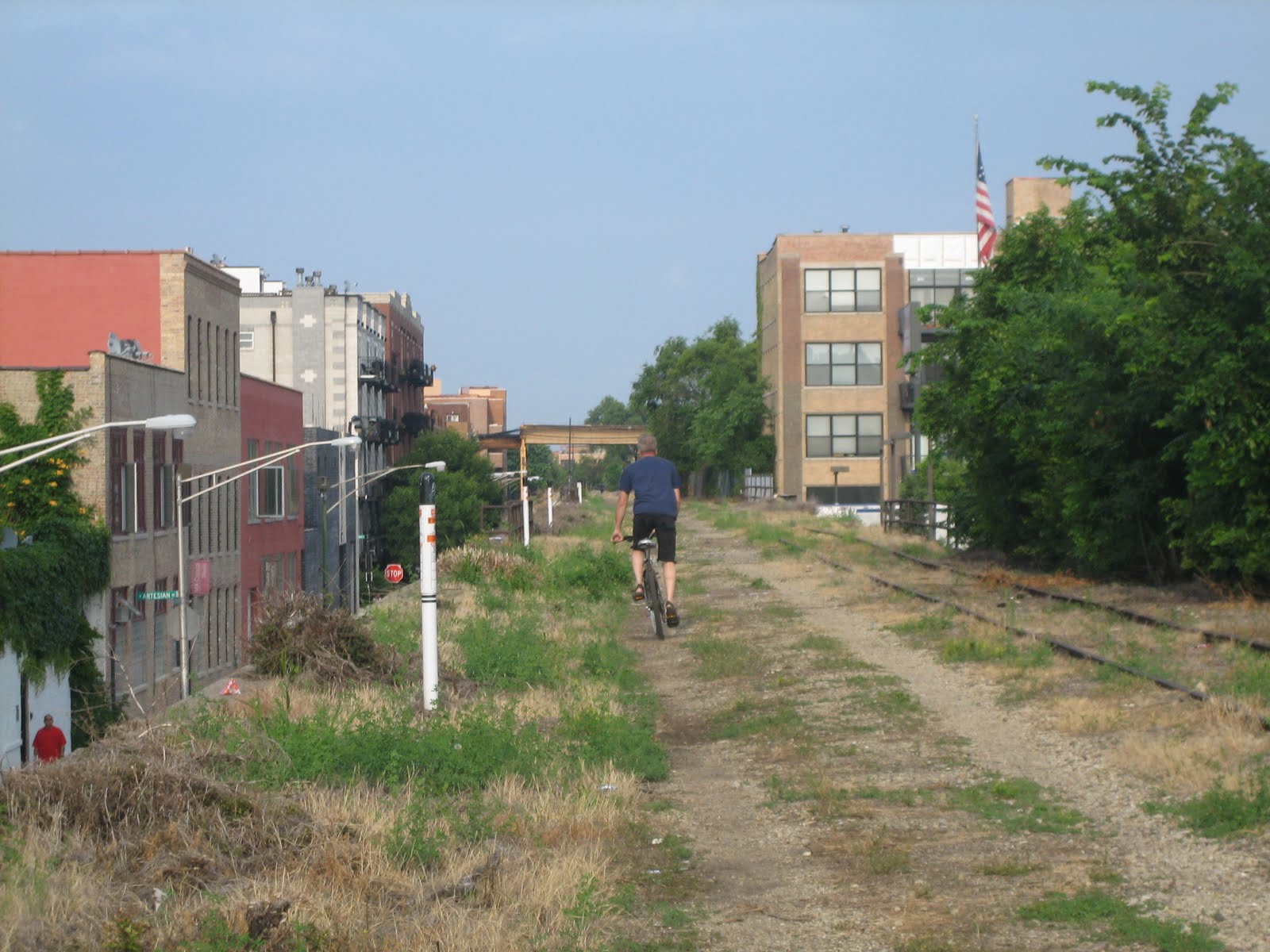
Chicago's Bloomingdale Line

New York City's High Line

As a follower, not a leader, in all these different categories, it’s no wonder Chicago dropped in Bicycling magazine’s ranking of the best large U.S. cities for biking, from first place in 2001, to tenth place in 2010. It’s not that things are bad here, it’s just that more exciting stuff is happening more quickly elsewhere.

Active Trans will be hiring a new director soon, and it will be interesting to see if this person will can light a fire under CDOT and other departments to make some of the above projects happen sooner than later. But again, Active Trans can only push so hard, because the advocacy group depends on the City for consulting dollars.

Unlike in liberal, temperate West-Coast cities where bicycling has long been popular and politicians have responded to demands from the public for better bike facilities, cycling in Chicago has traditionally been a “top-down” affair. Under Daley, the City has installed paths, lanes and racks in an effort to coax people out of their cars.

But now that Chicago cycling has gained momentum while CDOT’s bike initiatives have lost steam, it’s time for a “bottom-up” approach. Citizens need to start pressuring City Hall to put the metal to the pedal.

It’s worked before. After seriously injuring herself when she wiped out on one of Chicago’s dangerous metal-grate bridges, in 2002 Kathy Schubert launched a letter-writing campaign demanding that the bridges be made safer for cyclists. The campaign infuriated then-CDOT Commissioner Miguel d’Escoto, but after receiving dozens of postcards, he ordered the Bicycle Program to start working on the problem. Eventually metal plates were installed on bridges at Wells and Cortland.

The Bike 2015 Plan, released in 2006, calls for the establishment of ten miles of “bike boulevards,” traffic-calmed, residential streets where cycling is encouraged because cars are forced to slow down, common in Portland, OR, Berkeley, CA, and other cities. Last fall Sarah Kaplan grew frustrated that little action had been taken on this proposal. She formed the grassroots group Bike Boulevards Now! to lobby the city to get moving on the idea. CDOT Bicycle Program Coordinator Ben Gomberg now says he’s hoping to establish Chicago’s first bike boulevard by 2011.

Bike boulevard in Berkeley, CA

If you want Chicago to remain a first-class bicycling town, contact your alderman, CDOT, or the Mayor’s Office to demand that the City starts implementing big plans for biking - now. Tell them you want immediate action on exciting projects like separated bikeways, on-street bike racks, a new bike station, a large-scale bike-share program, City-funded ciclovias and the Bloomingdale Trail. Or, better yet, form your own grassroots, recruit members via the Chainlink, and start organizing for change. It’s time to put the rubber on the road.

A Car-Free Exodus to Zion


Cult history, Cajun food and a golden pyramid await you on this car-free camping trip

By John Greenfield

[This piece also runs this week in New City magazine: www.newcity.com.]

There’s a bunch of state parks near Chicago accessible by commuter rail and/or bicycle including Indiana Dunes, Chain O’ Lakes and Kettle Moraine. But the easiest, oddest camping trip you can take without a car is a weekend excursion to Illinois Beach State Park in Zion, hometown of the band Local H, near the northeast corner of the state.

Strap your gear to your bike and catch Metra from the Ogilvie Center, 500 W. Madison, or points north (metrarail.com.) Alternately, you could bring a backpack and hike two miles from the Zion station to the campground, but a set of wheels is useful for sightseeing.


From the station, head 1.5 miles south for lunch at Captain Porky’s, 39210 Sheridan Rd. This seafood and BBQ shack, decorated with a piggybank collection, plastic sharks and a taxidermied alligator head, specializes in cheap and yummy New Orleans-style grub like shrimp po’ boys, crawfish and jambalaya. “Eat here once and you’ll be back again,” says owner Dino Kallianis. Around the corner, Al’s Tap and Package Liquors, with it’s old-school neon sign, looks like good place to tie one on.


If you bicycled, head west from the Captain’s on Wadsworth Rd. six miles and a bit south to the Gold Pyramid House, 37921 Dilley’s Rd. in Wadsworth. Years ago, local construction mogul James Onan built this six-story home, a 1/100 model of the Great Pyramid of Egypt surrounded by a moat filled with sharks and jellyfish. It’s supposed to be the world largest 24-karat-gold-plated structure. A 200-ton, 40-foot statue of Ramses stands guard in front and the gates are decorated with busts of King Tut, hieroglyphics, sphinxes and sarcophagi.


Backtracking a mile east on Wadsworth takes you to a trailhead for the Des Plaines River bike path, which runs north/south through serene wetlands where you might spy a blue heron. Returning to Sheridan and Wadsworth, you’re at the entrance to the state park, so pitch your tent under a canopy of evergreens and take a walk on the shore. Though it’s a far cry from the splendor of the Indiana Dunes, Illinois Beach’s pebbly lakefront does offer plenty of flat rocks for skimming, creepy, boarded-up, ‘50s-era beach houses and a view of the defunct Zion Nuclear Power Plant.


In the morning, take a stroll or a spin along the park’s many rustic paths, where you’re likely to encounter extremely tame deer. At the north end of the park the North Point Marina, Illinois’ largest, is a good spot for a picnic.

Afterwards, stop by the Zion Historical Society at Shiloh House, 1300 Shiloh Blvd., 847-746-2427, for a tour of the lovely Victorian home of John Alexander Dowie who founded the city in 1901 as a headquarters for his sect, the Christian Catholic Church. The town’s origins as a theocracy are still evident from north-south streets with biblical names like Sheba, Horeb and Gideon.


The Santa Claus-like Dowie was a benign dictator, but his successor Wilbur Glenn Voliva was a harsh ruler, banning pork, shellfish, smoking, alcohol, movies, opera, doctors, tan shoes, high heels and globes, since he believed the earth is flat. When he died in 1942 the sect faded into obscurity, although its house of worship, now called Christ Community Church, is still located in the center of Shiloh Park, and some Zion old-timers still avoid pig.


Before you catch the train home, stop for Sunday dinner at the friendly Star Lite diner, 2325 N. Sheridan, a few blocks north of the station, to break bread with a cross-section of Zionites. The huge meatloaf platter is recommended, but Reverend Voliva is long gone so don’t be afraid to order the pork chops.

Bridgeport: the Community of the Future

Clare Knipper by the Healthy Food

By John Greenfield

[This article also runs in the current issue of Momentum magazine, http://momentumplanet.com.]

When Blue City Cycles co-owner Clare Knipper calls Bridgeport the “Community of the Future” she’s only half kidding. Sure, this quaint, meat-and-potatoes South Side neighborhood is known for the Union Stock Yards, the Daley dynasty and the White Sox. But recently the area’s seen an influx of forward-thinking artists, activists and entrepreneurs, and it’s become an unlikely hotbed for bicycle projects and green initiatives.

Why? “It’s affordable and close to downtown,” says Knipper. “But it’s a little off the map so it draws the intrepid, people who are more in tune with bike and environmental concerns. And it’s got a lot of fun old-timey stuff.” As such, it’s a great destination for a pedal-powered daytrip.

Settled in the 1830s by Irish immigrants who dug the I & M Canal, and now home to large Chinese-, Mexican-, Italian- and Lithuanian-American populations as well, Bridgeport is bounded roughly by the Dan Ryan to the east, Pershing Road (3900 S.) to the south, the Chicago River to the north and Bubbly Creek to the west. The latter is so called because slaughterhouse workers used to dump offal into the water, causing it to bubble with gas from decomposing carcasses.

Ground zero for Bridgeport’s bike and sustainability endeavors is Bubbly Dynamics (bubblydynamics.com), named after the fetid creek, a former paint warehouse at 1048 W. 37th St. “Green developer” and cyclist John Edel completely rehabbing the derelict three-story structure, using salvaged building supplies that otherwise would have wound up in landfills. Other eco-friendly features include energy-efficient heating and ventilation systems, a green roof for storm water management, and showers and indoor parking for bike commuters.

John Edel on Bubbly's green roof

Officially called the Chicago Sustainable Manufacturing Center, the building houses a number of light industrial workshops and community-oriented businesses. “All the tenants are learning to be more sustainable by operating here,” says Edel.

Edel is currently shopping for a space for his next project, called the Plant (plantchicago.com), which will include larger manufacturing spaces, a warehouse for salvaged construction materials, and a “vertical farm” that will grow food in the air, inside the building.

Yuval Awazu of UV Metal Arts (uvmetalarts.com) moved into Bubbly five years ago. He fabricated his own sandblasting booth and powdercoating oven for painting bikes custom colors. He’s also built some unique rides: choppers, tall bikes, and a six-wheel vehicle called the “Sex Cycle.” He contributed his metal working talents to the building rehab; in exchange, Edel gives him a break on the rent. “For me and the guys who build bike frames upstairs, Bubbly is like an incubator,” says Awazu.

Yuval Awazu

Owen Lloyd, one of the five frame builders from the Bubbly Bicycle Works cooperative, agrees. Each pays only $200 a month for workbench space and shares equipment like “jigs” used to shape frames and forks, and the “surface plate,” a perfectly flat 3,000-pound slab of granite for checking alignment. “John Edel’s the reason we’re here,” says Lloyd. “If he was a regular landlord and I was paying regular rent I wouldn’t be able to do this. He’s a visionary.”

Lloyd at Bubbly Bicycle Works

Not that Lloyd has much time for frame building these days. Along with Clare Knipper, he’s busy running Blue City Cycles (www.bluecitycycles.com) which opened at 3201 S. Halsted in March (see Momentum issue #42). This winter they’re offering a $100 winterizing tune-up package and hosting a maintenance workshop series.

John Salhus

Nearby at 32nd and Morgan, artist John Salhus operates a different kind of bike shop, refurbishing old rides in his painting studio. “For me working on bikes is like Prozac,” he explains. He also wrenches for low-income neighborhood folks who stop by. Recently Salhus built a shrine to randoneurring pioneer Paul de Vivie, the “patron saint of cyclists,” for the Day of the Dead exhibit at the nearby Museum of Mexican Fine Art.

Down the street at 3219 S. Morgan, the Co-Prosperity Sphere (coprosperity.org) is an “experimental culture center” that’s an anchor of the local arts community. The building’s home to founder Ed Marszewski’s Lumpen and Proximity magazines, as well as gallery and performance space.

The other lynchpin of the Bridgeport arts scene is the Zhou B. Arts Center (zbcenter.org), 1029 W. 35th. Founded by brothers Shan Zuo and Da Huang Zhou, this huge space houses galleries, studios and a stylish café.

Sox/35th Red Line station

A mile east on 35th is the CTA’s Sox/35th Red Line station, one of four stops that recently got high-capacity indoor bike parking. The double-decker racks at Sox/35th, with space for 42 bikes, are located in the “paid” area of the station for extra security.

If you bike to Bridgeport, a new green space called Stearns Quarry Park, 2700 S. Halsted, is a great place to take a break. Formerly a limestone quarry, then a landfill, the space has been reclaimed as an urban oasis with a fishing pond, a waterfall and a hilltop 33 feet above street level offering a breathtaking view of the Loop – perfect for a picnic.


Halsted Street, the neighborhood’s backbone, feels like the main street of a careworn small town, except nowadays the roadway is striped with bike lanes and lined with parking racks. The Pants Store, 3513 S., is a great place to buy Dickies and have them shortened into cycling knickers while you wait. Monster Island Toys, 3335 S., features an amazing collection of sci-fi and horror action figures, including a three-foot-high plastic Godzilla. Augustine’s Spiritual Goods, 3327 S., sells books on religion and philosophy, incense and scented oils.

Halsted Street

Bridgeport also boasts many historic houses of worship worth a gander. Founded in 1882 for Polish stockyard workers, St. Mary of Perpetual Help Catholic church, 1039 W. 32nd St., features soaring bell towers and a domed cupola. Reflecting the recent influx of Chinese immigrants to the neighborhood, Ling Shen Ching Tze Buddhist temple, 1035 W. 31st, is a vibrant red building with fluttering prayer flags outside and an ornate golden altar within.


Another nearby sight worth pedaling to is the Stock Yard Gate, just west of Halsted at Exchange St. (4200 S.), a massive limestone arch crowned by a steer’s head. It once marked the entrance to the huge packinghouse district, setting for Upton Sinclair’s The Jungle.

Ready to refuel? Next door to the defunct Ramova Theater, Ramova Grill, 3510 S. Halsted, is famous for Cincinnati-style chili. Meals at Taqueria San Jose, 3253 S. Halsted, include a side of pickled carrots, onions and jalepenos. Healthy Food Lithuanian restaurant, 3326 S. Halsted, belies its name with dishes enriched with butter, bacon and sour cream. [Sadly, the Healthy Food recently closed.]

Nana cafe

Ed’s Potsticker House, 3139 S. Halsted, serves unusual Chinese entrees, like sautéed lamb with cumin, and fried fish with cornbread. Just opened at 3267 S. Halsted, Nana is a sunny café serving organic breakfast and lunch. Bridgeport Coffee House, 3101 S. Morgan, in a beautiful corner space with a hammered tin ceiling, is a cozy place to laptop.


Thirsty? Bridgeport’s famous for corner taps and “old man bars.” Tucked away at 3200 S. Wallace, Redwood Lounge is a dive with cool retro signage outside, and redwood paneling and Christmas lights inside.

Kaplan's Liquors

The mother of Co-Prosperity Sphere’s Ed Marszewski owns Kaplan’s Liquors (AKA Maria’s), 960 W. 31st, which explains why the bar sports a creepy collection of marionettes and ventriloquist’s dummies.


Why not hop on your bike and find out why the “Community of the Future” is a great place to hang out today?

Thursday, September 2, 2010

Jane Healy discusses Active Trans' new director

Jealy Healy with her daughter

by John Greenfield

[This interview also runs on Gapers Block, www.gapersblock.com.]

After a long search process, Active Transportation Alliance recently selected Ron Burke as its new executive director, replacing Rob Sadowsky who left in June to lead the Bicycle Transportation Alliance in Portland, Oregon. Burke, an expert in environmental policy, comes to Active Trans, the region’s advocate for better walking, biking and transit, from a job with the Union of Concerned Scientists. Before that he worked for the Illinois Environmental Protection Agency.

Ron started work at Active Trans this week. Last week Active Trans board president Jane Healy, who has spearheaded Safe Routes to School initiatives in her hometown of Blue Island and is a familiar face on Chicago Critical Mass rides, agreed to talk about the appointment. She discussed why the board chose Burke from a field of more than 75 candidates, the concerns that his marriage to a current Active Trans employee might be a conflict of interest, and Healy’s hopes for the future of the organization under its new E.D.


Can you tell me about Ron’s background in promoting green transportation and active living initiatives?


When he worked for the American Lung Association, Ron was really key in pushing for CATS [Chicago Area Transportation Study, now called Chicago Metropolitan Agency for Planning, an agency which helps award grants to local transportation projects] to use some of the federal CMAQ [Congestion Mitigation and Air Quality] dollars for bike, pedestrian and transit projects, not just for car infrastructure.

[Active Trans co-founder and longtime executive director] Randy Neufeld was part of the second round of interviews. Randy had worked with Ron on the CMAQ stuff and said that was one of the high points of Randy’s career, and that Ron had been really key for a lot of that progressive thinking. Before that people had assumed that CMAQ money was going to be used for car projects [like timing traffic lights so that cars would spend less time idling at red lights, theoretically reducing emissions.] They really had to challenge the status quo and make people think in different ways.

Any other involvement with transportation issues?


Until recently he was working at the Union of Concerned Scientists [an organization which uses scientific research to lobby for government policy changes to address pressing environmental and social problems] and he’s done a lot of things to promote carbon neutrality. Some of that involves transit issues because that’s a really good way to improve things on that level.


Ron Burke, left, at an environmental demonstration

Can you tell me anything about the other candidates?


We had over 75 applications, including lots of really impressive candidates. It wasn’t just [former Chicago Department of Transportation commissioner and current Active Trans board member] Cheri Heramb and myself who were vetting the candidates. We hired an outside consultant [David Erickson Pearson from Colorado] and he told us he was really surprised how good the depth of field was. He was very impressed that we had so many and that we also had a lot of diversity. We had a lot of women applying, and although you can’t ask questions about [race] I would say we had quite a bit of diversity among applicants.

We narrowed it down to about 15 really stellar candidates, based on their resumes. And then we narrowed that down a little and interviewed ten people in depth. That was a phone interview process but it was a long phone interview process. Of the standout candidates there were two people who really came out as top candidates and four who came out as really good, strong candidates. For those people we pulled together the largest search committee from the board and spent several hours interviewing them.

What qualities were you looking for?


Lots of them. We were looking for someone who had developed a budget and had some experience on the fiscal end. We were looking for someone who really got our mission and our vision and who we felt would be a really good role model, who could live the life and represent the organization. We wanted someone who would be comfortable speaking before the media whether it was on the radio or on camera. We wanted someone who was a very good communicator, who could get our message out with key players and help to make change and promote our mission and our vision. Our strategic plan’s really mapped out, so we wanted someone who could tie into that strategic plan and help us get to next level. Obviously someone with management skills. We’ve got a great staff and we don’t want to lose people. We want someone who’s personable and works well with others, that basic, fundamental skill that managers have to have.

What do you think Rob Sadowsky’s greatest strengths were as head of Active Trans, and his greatest achievements?

Rob was an amazing strategic thinker. He was really good at looking at the long range and looking at the steps that we’d need to take to get to that long range. I think that was an amazing strength that he had.

What were some of the highlights of his tenure?

We were able to bring on a ton more staff to help achieve our goals, from 20 to 40 people. We went for some legislative wins that were really impressive, not the least of which just happened this year. They totally expanded the Safe Routes to School program, which I think was really impressive.

Ron is married to [Active Trans’ Near West Suburban Coordinator] Pamela Brookstein, who’s been on staff for 12 years. Were there any concerns about that being a conflict of interest? Or was that a positive thing to hire someone who’s been involved with the organization by marriage for a long time?


We definitely took it very seriously and we were concerned about a conflict of interest. We thought it would be a very awkward situation to have an executive director who was overseeing a staff member who was his spouse. Ron did actually say, “I don’t want to supervise my wife,” and we didn’t want him doing that. So we did put some things in place to address that issue. As it happened Pamela wound up taking another job [working with a new Cook County Department of Health anti-obesity initiative called Communities Putting Prevention to Work] so it’s a non-issue.

We also felt that it was a positive because he really does understand our mission. Pamela has been extremely successful on the West Side, working to put a lot of things in place and reaching out to communities. And Ron really gets bicycle and pedestrian and transit issues since Pamela’s been working on them for years. He understood about Open Streets [a program that shut down a street network for car-free recreation], he knew about the expansion of our mission, he really understood that.

What are the challenges ahead as Ron takes this job, and what are your goals for the future of the organization?


I don’t have a lot of worries. I think Ron is eminently qualified. He came through with amazing recommendations, he was so impressive in the interview process and he’s a very personable person.

We have a very clearly-defined strategic plan – it’s aggressive. So I think my only fear is that he’s going to come in and be overwhelmed by how aggressive that strategic plan is. But I think he’s up to the challenge. We need someone who’s really willing to take the bull by the horns and make change and Ron’s that guy. He’s going to hit the ground running. He’s already had a ton of experience with other organizations and I think he’s really ready to push us to that next level.

What are a few of the highlights of the strategic plan for the next few years?

Our goal is that we’re going to make major strides in changing how people get around the Chicago region. I hope we can get that 50 % pedestrian, bicycle and transit mode share, I hope we can get that 50 % reduction in crashes that the plan calls for. It’s a public health issue that needs to be addressed.

Anything else you’d like to tell me?


I really think we got a phenomenal candidate and I was so pleased that we were able to find such a qualified person to step up to the plate. We’re a non-profit so there’s not big bucks in this. And there’s always the fear that you’re not going to get qualified people because you’re not offering some huge salary. I was so impressed with the applications we got, so it was really nice to feel like you were making a discernment between highly-qualified candidates.

I really think Ron is going to be a superb leader. We have a very exciting mission – we’re very ambitious with where we’re going and I really want to see it happen. I think Ron’s the guy to do it.

Wednesday, September 1, 2010

Boulevards of Broken Dreams

One of Chicago's 2008 Sunday Parkways events

Car-free "ciclovia" events are flourishing in cities across the country. So why did Chicago's fizzle?

by John Greenfield

[This article also runs in Time Out Chicago, www.timeoutchicago.com.]

In 2003, Randy Neufeld, cofounder of Active Transportation Alliance (ATA), formerly Chicagoland Bicycle Federation, came home from Bogotá, Colombia, jazzed about the Sunday Ciclovia. The weekly event, happening since 1982, closes a 70-mile road network to cars so 2 million people can walk, bike, play and dance in the streets.

“It’s amazing to see so many people out and active,” says Gin Kilgore, a Chicago cyclist who recently rode in Bogotá’s ciclovia (“bike path”) with her three-year-old son, Miguel. “It’s a completely safe, celebratory experience.”

Bogotá’s Sunday Ciclovia

Soon after Neufeld returned, ATA, a nonprofit that promotes walking, biking and transit use in Chicago, began lobbying the city to stage a ciclovia to encourage healthy recreation. In 2006, the Chicago Department of Transportation (CDOT) released its Bike 2015 Plan, which called for establishing Sunday Parkways, a car-free event on a route linking major West Side parks via the boulevard system.

Despite this endorsement, various city agencies declined to take responsibility for organizing or recruiting sponsors for the ciclovia. “Not all strategies included in the plan are designed to be managed or implemented by the city,” explains CDOT spokesman Brian Steele. “In these tight economic times, it is difficult to secure funding for events like this.”

Chicago's 2008 Sunday Parkways

Instead, ATA shouldered all the fund-raising, $400,000 in 2008 and $300,000 in ’09. In 2008, the group staged two events on two different 3.5-mile routes through Pilsen, Little Village, Lawndale, Humboldt Park and Logan Square. The two routes were combined last year into the one-day, seven-mile Open Streets, which drew 12,000 participants.

Meanwhile, the ciclovia movement has gained a toehold in other cities. In 2010, New York City is staging three events, San Francisco is putting on nine, and Portland, Oregon, is holding five. Even car-culture meccas like L.A. and Atlanta are taking the concept for a spin.

Portland's Sunday Parkways

But Chicago is not staging a major ciclovia this year. ATA’s recently departed executive director, Rob Sadowsky, says the stakeholders committee—an ATA-assembled collection of community and public-health orgs that raises support and awareness for the ciclovia—decided not to organize one this year because less grant money is available from the Chicago Community Trust, one of the major funding sources.

Asked why other cities are expanding their programs while Chicago’s stumbled, ATA spokesman Margo O’Hara points to government support. “The major difference is [governments in] those other cities have taken it on from the beginning,” she says. “In New York City, it was the New York Department of Transportation that committed to providing Summer Streets to residents.”

New York's Summer Streets

San Francisco’s Sunday Streets draws about 20,000 people per event, according to the San Francisco Bicycle Coalition’s Renée Rivera. She credits Mayor Gavin Newsom and his staff: “They did the initial fund-raising to get this started two years ago.”

Lucy Gomez-Feliciano from the Logan Square Neighborhood Association, part of the Open Streets stakeholders committee, says this kind of city support for a ciclovia is lacking in Chicago. “It’s treated just like the marathon, where it’s allowed to happen by the city but the event has to provide all the funding.” Advocates like Gomez-Feliciano say cities should help make ciclovias happen because they promote health and connect communities—and, unlike the marathon, it’s free to participate.

2009 Open Streets; Gomez-Feliciano is at far left

The stakeholders committee is now raising cash to hire a staffer to work exclusively on making the ciclovia a dependable event, says Gomez-Feliciano. “To hold Open Streets once a year is not our goal,” she says. “Our goal is to be part of the culture of the city, as it is in Latin America.”

Greenline Wheels opens in Oak Park


by John Greenfield

[This piece also appears in New City, www.newcity.com.]

It’s the grand opening for Greenline Wheels, an “eco-happy” bike and electric car rental and tour center in Oak Park, and the land of Wright and Hemingway looks like an active transportation utopia. Just south of the futuristic Harlem CTA stop, Marion Street is closed for the block party.


A dude in a Hawaiian shirt tows kids on a pedicab, a cop rolls a Segway, folks check out a PT Cruiser-like electric buggy and a pair of cheerleaders pedals a tandem. The new venture hopes to lure visitors out to the western ‘burbs to explore architectural and historical gems, while providing locals with green transportation options.


Co-owner Mary Jo Schuler tells the crowd the shop is officially designated as an LC3 “low-profit” business, a new model in Illinois. After local bigwigs cut the green ribbon in front of a phalanx of shiny new rental bikes, dozens of folks parade around the block on various non-noxious vehicles.


Afterwards, Schuler explains why she started this new business, “The village of Oak Park continues to get more congested with cars and instead of whining I wanted to do something about it.”

Green Line Wheels, 105 S. Marion, Oak Park, 708-725-7170, greenlinewheels.com.

Wednesday, August 4, 2010

OK to bike on the Lakefront Trail after 11 pm?

[Image courtesy of www.bikecommuters.com.]

By John Greenfield

[This piece also runs in Time Out Chicago, www.timeoutchicago.com.]

Q: If Chicago’s parks and beaches are public property, then why can police kick people out at 11pm? Is there some sort of loophole that will let me use the parks after closing time?

A: The Chicago Park District’s legal code says beaches and parks are off-limits from 11 pm to 6 am, with exceptions made for events like the vampire-friendly L.A.T.E. Ride. “Those hours are set for the safety of patrons,” explains park district spokeswoman Marta Juaniza. To prevent drug dealing, prostitution and violent crime? “Whatever can happen in the dark,” Juaniza says.

Friends of the Parks’ Erma Tranter supports the curfew, noting New York has similar rules. “If there’s a basketball game going on after midnight, that’s a problem for people who need to sleep.” But if you want to use the Lakefront Trail for a late-night jog or to pedal home after last call, you’re in luck. Tranter says cops generally don’t ticket trail users. “They use common sense and don’t bother people who are recreating,” she says.

“Responsible users are not being hassled,” agrees Active Transportation Alliance’s Adolfo Hernandez, adding his group wants to see this de facto policy made official. “People rely on the Lakefront Trail for their commute during all hours of the day.”